236: SLPs Role with Literacy and Writing

Show Notes:
Hey, there SLPs! In this episode, we have Brianna Guild – a private practice Speech-Language Pathologist in Ontario, Canada, providing virtual speech therapy focusing on literacy, language, and articulation. She created SLP Literacy Corner, sharing literacy resources and ideas for busy educators.
Join us as Brianna discusses creating effective writing goals, utilizing graphic organizers, and seamlessly integrating oral and written language skills. Plus, get her recommendations for animated shorts and non-fiction text resources to enhance your therapy sessions. Tune in for inspiration and practical strategies to elevate your speech therapy practice with older students!
Here's what we learned:
- Incorporating students' personal interests into literacy-based therapy increases engagement and motivation, making learning more meaningful and impactful.
- Interconnected oral and written language goals promote meaningful progress when addressed simultaneously.
- Setting realistic writing goals for students instead of focusing solely on grade-level expectations.
RESOURCES
Learn more about Brianna Guild:
Instagram: @slp.literacy.corner
Freebie LinksFREE literacy handouts
Learn more about Hallie Sherman and SLP Elevate:
🎧 Check out the Secondary Secret Podcast here!

Where We Can Connect:
Subscribe & Review on Apple Podcasts
Are you subscribed to the podcast? If you’re not, I want to encourage you to subscribe today so you don’t miss any future episodes! I already have so many amazing guests and topics lined up, I would hate for you to miss a single one! Click here to subscribe on Apple Podcasts.
Could I ask a big favor? If you are loving the podcast, I would LOVE it if you would leave me a review on Apple Podcasts. I read each and every review. Plus, you get to pay it forward because it will allow other teachers like you to find the podcast! Wondering how to leave a review? Click here to review, then select “Ratings and Reviews” and “Write a Review”. So easy and so appreciated!
Do you have a question you would like me to answer on the podcast?
GREAT! CLICK HERE TO FILL OUT THE FORM!
TRANSCRIPT
00:00:00 Hallie: Welcome to SLP Coffee Talk, the podcast designed exclusively for speech-language pathologists who work with older students, grades 4 through 12. I am your host, Hallie Sherman, your SLP behind Speech Time Fun, the Speech Retreat Conference, and the SLP Elevate membership. And I'm thrilled to bring you conversations, strategies, and insights that will give you the jolt of inspiration that you need. Whether you're tuning in during your morning commute, on a break in between sessions, or even during a well-deserved relaxation time. I am here for you each and every week. Let's do this SLPs.
00:00:46 Hallie: Welcome here to my Instagram Live, where we're going to be talking all about literacy-based activities and writing activities for speech therapy. I don't even think this is working. I'm going to take these off. And I'm waiting for my guest. Wait. Oh, there she is. Welcome, welcome, welcome. Hi, everyone. Oh my goodness, I love this. Yay!
00:01:11 Brianna: Hello!
00:01:12 Hallie: Hi!
00:01:14 Brianna: Hi, nice to see you this evening.
00:01:15 Hallie: Good to see you. Thank you so much to everyone that's joining us here tonight. We're gonna be talking all about literacy and writing goals and writing activities and speech because that's a big part of our job.
00:01:26 Brianna: Absolutely.
00:01:28 Hallie: Let's get everyone watching. Let's introduce both of ourselves. Hi, I'm Hallie Sherman. I'm from Speech Time Fun and I'm a speech language pathologist here in New York, and I'm an expert in working with grades four through 12 since that was my jam for the majority of my career. Brianna, who are you?
00:01:42 Brianna: I am from Ontario, Canada. I'm a private practice SLP, and I provide primarily literacy services virtually to clients, and I am the creator of SLP Literacy Corner.
00:01:58 Hallie: Awesome, and let's share, when it comes to literacy-based therapy, why do you love incorporating that into your speech therapy practice?
00:02:05 Brianna: Oh, I don't know where to begin there. Literacy is necessary to participate in society, to first of all, like achieve academic success at school, but then also to participate in everyday activities like texting as we get older and then jobs. Like we absolutely need literacy skills. They are crucial.
00:02:30 Hallie: So, I love that you said texting, like that's so relevant to our students. When we say to them, like, hey, write, and they're like, “why?” “Why will I ever need to do that?” Well, you actually will need to when it comes to texting your friends, like that could be really important. So I love that, that we incorporate writing and reading. I love that.
00:02:49 Brianna: Like we want our friends to be able to read our texts and we need to be able to read our friends' texts.
00:02:54 Hallie: Can you share a fun activity that you might do to incorporate that?
00:02:57 Brianna: Off the top of my head, even just thinking about that sentence structure, right? And how would we text our friend a sentence about wanting to hang out or if we've got a question for them. And when it comes to writing we do have the different styles too. Like a formal writing for school is going to look different than that text writing. So it's even a good activity to show students that there's different tasks and purposes when it comes to writing and our text language is different than a more formal language.
00:03:31 Hallie: I love that. I love it. Let us know in the comments, like, do you guys incorporate texting as part of your speech therapy activities? One of my favorite sites is iFakeTextMessages.com and it's a site where you can, like, create fake text, exactly what it is. You can create fake text messages and you can do it with your students. You get to be creative, like, is it an iPhone? Is it an iMessage versus not? And it really teaches how to respond, do different code switching, like, with your texting a parent versus a peer, and it might be a little bit different. Ooh, I used to use emojis. I love that for sarcasm and emotions. I love that.
00:04:07 Brianna: That's really good.
00:04:08 Hallie: Even like emoji sites, like emoji dictionary, like all those kinds of things where you can easily pull up any sort of emoji. I love that. I love that, I love that. What are some of your favorite books to incorporate some literacy-based activities?
00:04:20 Brianna: Oh, that really depends on the client. I like really follow my client's interests. I feel like with my younger clients right now, there's a lot of Pete the Cat, Dora the Explorer happening. With some of my older clients, actually, I started doing a book study with one of them with the Skeleton Creek books. I'm not sure if you're familiar with those, but one of my students was reading it at school and they told me about it. And then, I was using it with another client in practice after I heard of it. It's a really cool book because at the end of kind of every chapter-ish, there's a video that you can go watch online. So it makes it super engaging and it is a mystery as well. So you have to follow along with what's happening. There's so many goals to work on with those Skeleton Creek books. They're really good if you're looking for a kind of middle school chapter book.
00:05:14 Hallie: I love that. I love it that it comes with a video that's so exciting. This just brings it to life and also like I love that there's just that continuity of lessons like it doesn't have to be an isolated about 30 minutes. We're gonna do something and never see it again.
With chapter books like it's okay to build upon it and not finish it in one session.
00:05:32 Brianna: Absolutely. Yeah, and when you do a book study, there's really so much, so much that you can cover goal-wise.
00:05:39 Hallie: I love that. I love that. What are some ways that you motivate your students who might be reluctant readers or avoidant readers to do some of these activities?
00:05:47 Brianna: That's really when I bring in those personal interests, like asking what kind of text they're interested in reading or what kind of books and making sure that we're following their lead to get them interested.
00:06:03 Hallie: I love that. I love this. I said, there's so many like graphic novels now and like even like since they're in Harry Potter or anything like that, there's so many ways that you can incorporate that. And this way, I heard someone say recently, “who cares what they're reading as long as they're reading?” Like we want them just to love reading.
00:06:19 Brianna: Absolutely, and I've done the Hunger Games with an older client as well, a high school client during the summer. One year we ran the Hunger Games because all their friends were talking about it and they have dyslexia and so, it was challenging for them to get through the chapter book. So we spent the summer reading the Hunger Games and then also we're working on chapter summaries to build that comprehension. We worked on an essay at the end and like, analyzed Katniss' character and pulled examples from the text so that they were working on an essay format as well because they are in high school. So I think when you pique the students' interests or ask them for their input, they get that sense of like, control over what's happening. And it wasn't just something that they were forced to do or told to do. They have a bit of that say in it.
00:07:08 Hallie: I love that, I love that. Cause it's like another teacher telling me to read again. Great, you just pulled me out of like, lunch or art or something fun where I wouldn't have had to read and now you're making me read, but giving them some choice like, hey, we're getting the next book study, let's vote on it. Like those things you just do, like those breakfast, like book, breakfast or book. I don't know. Like showcasing all the
00:07:33 Hallie: Oh, you read Wonder with a student. It was love that, love that incorporating. Yes, so books that like has been movies that they might've seen, not seen, be curious about one book. I like utilizing with my older students is even just Chicken Soup For The Teenage Soul, for the pre-teen soul. It has a lot of different stories on there, written maybe by a teen or like someone reflecting on their teen years, and it's just stories that they can relate to, and it's two, three pages that you can get through. You can make a photocopy, and it's just like when they hear that, like it's a real story. Oh, that's happened to me or I can relate to that. I know that's happened to someone else. One of my favorite ones in the pre-teen book is all about a solo and that girl or a Wisconsin girl. She always tried out for things, never got it. She finally got a chance and got nervous. So not only were we able to incorporate a lot of literacy-based goals, but also talking about like growth mindset and not being afraid to go for something hard and challenging when you make mistakes and all that fun stuff. That is just some good thematic stuff to incorporate. I know you love utilizing writing activities. You mentioned writing an essay. I can tell probably a lot of people listening and watching right now is going, “she got them to do what?” Can you share how you inspire a student to be motivated to write an essay?
00:08:55 Brianna: Well, first of all, it's something that they have to do in high school, right? So we spend a lot of time with like, this is something we're going to be expected to do at school. Let's practice here. Let's get the structure down here, find organizers that work for them and then that way, when we have to do it at school, it's not overwhelming and new. And I do encourage my students to advocate for if they have organizers with me that they use and that work well for them to ask their teacher if that can be what they use at school as well. So far, my students have had success with that which is nice that the teachers have been flexible in that way, but I think that the combination of you know, talking about why we're doing it.
00:09:39 Brianna: Some of these things we're doing in session with me because there's an expectation we're going to have to do it at school, and we want to make that easier for you. How can we do that? And then the topics that I write about, I'm always giving choice. I'm never giving one topic and that's what we have to write about. If we're doing an opinion piece, we might either come up with a topic together or some of my students who do need some choices, I'll give just two or three choices for them to pick from, but always having that bit of choice involved, the interest, and the understanding why. I think that's kind of the ways I try to get students motivated.
00:10:17 Hallie: I love that. We just got a question now. I'm gonna ask you, students hate graphic organizers because then they have to write it all over again. Any advice, tips on how to motivate the students to like, you're not doing it twice?
00:10:30 Brianna: Yeah, so I think the big thing is that if you're writing it in full on a graphic organizer, in my opinion, that graphic organizer probably isn't being used in the right way because it shouldn't be full, complete. To the point of your entire essays being written once on a graphic organizer. And then again, in your writing. How I tend to use graphic organizers is almost like just a step above a brainstorm. Like we'll do an oral brainstorm and then we'll write down our, like our points. And I tend to not be a perfectionist with the graphic organizers like, if they're not using the punctuation and all of that on a graphic organizer, that's fine.
00:11:11 Brianna: I'm just, I want you to get your ideas out and organize, and then we'll polish it and put it into the writing, so you're not doing it twice, and on the note of organizers, there's a book I read recently that I would recommend, a writing rope. The organizers in here are fantastic. And this is the writing organizers that I have started using. If you get the book, the downloads, there's like a code where you can go on the website and download the organizers and all these different really helpful handouts, and those are the ones that I really like and use now.
00:11:44 Hallie: I know you shared recently on your social media, like a quote, some evidence about languages' role in writing. And I know a lot of SLPs wonder, like, is that our scope? Is it not our scope? Are we a writing teacher? Are we not? Like, what would you say to someone saying, like, what is my role when it comes to writing?
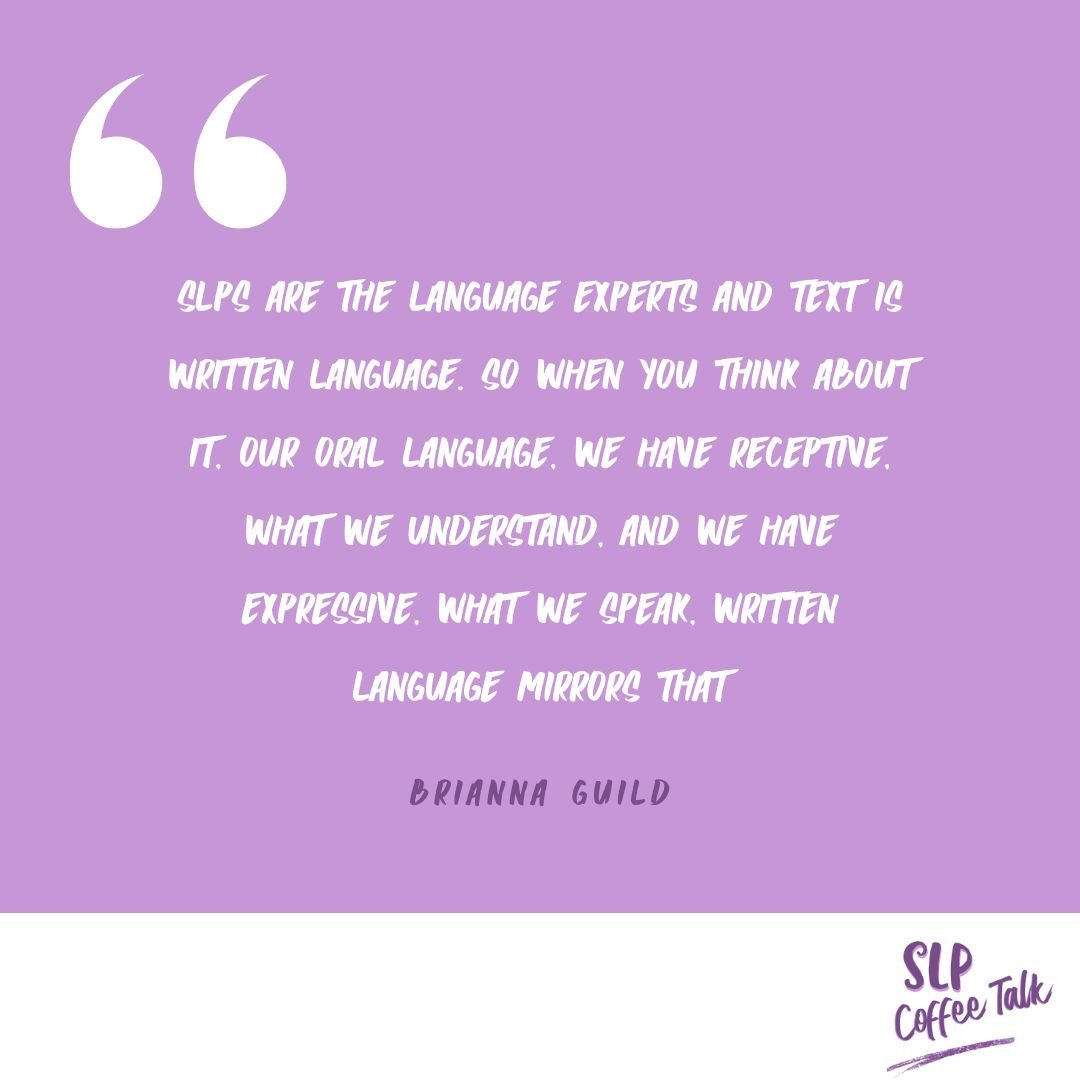
00:12:02 Brianna: So SLPs are the language experts. And text is written language. So when you think about it, our oral language, we have receptive, what we understand, and we have expressive, what we speak, written language mirrors that. So our receptive is reading and understanding, and our expressive is the writing piece. So they really, they're integrated. You can't really separate them out from each other. And there's a lot of studies showing that if you strengthen skills in either domain like written or oral, then you're strengthening the other too. So they're so intertwined. You really are working on one when you're working on the other.
00:12:45 Hallie: I love that. I know often when we work, especially with the older ones, we'll want to make sure our lessons are relevant and we want to ensure that carryover. This is the way to get that. It's like, for carryover, make your activities really aligned to the curriculum without even having to bring the curriculum in. Like I know I always struggle to find out what the teachers are doing or my students would never bring their homework assignments because I don't want to have to do that there. But instead of just practicing these skills that we know they need in the classroom anyway, it's an easy way to make our activities relevant and showing them, hey, when your teacher asks you to write an essay where you're referring back to the text, this is how you can do it.
00:13:21 Brianna: This is how we can do it, and let's practice here with the text that you're interested in and it's engaging for you or pulling in that curriculum too, like you're saying, if they're learning about something, you know, in science or in social studies that they're really interested in learning more then capitalize on that, bring in some more texts about that thing that they're interested in and that always helps build the background knowledge too, which is so important.
00:13:45 Hallie: I love that. Do you have any favorite resources for working on non-fiction texts?
00:13:50 Brianna: There was a website I loved. It was called DKfindout! and it closed this year and I'm so upset. They did not consult me about this. I've been using a lot of Britannica Kids, I use some read works, but I'm on the hunt honestly, for some more nonfiction texts, cause my go-to got taken down.
00:14:11 Hallie: I know. And I–
00:14:13 Brianna: What about you?
00:14:14 Hallie: I never got annoyed when Newsela started filtering out the amount that they would provide for free. I'm like, come on! I love being able to access this live in the moment, like right after the Super Bowl. It was a Super Bowl thing when like the royal wedding, things that were just around was there. Like, I just love being able to use that. So I've been utilizing a lot of Wonderopolis. That's been my go-to for just texts on topics, like you can find anything from what is a refrigerator to why are marshmallows sticky, to like anything under the sun. You had a question about what about examples on such an IEP goal for writing?
00:14:54 Brianna: I don't set IEP goals because I'm in private practice.
00:15:00 Hallie: What would be your goal if you had to write a formalized goal? Would you have an example? Well, yeah. Like a session objective.
00:15:05 Brianna: Yeah, to be fair. Okay, yeah. So I do obviously write treatment plan goals in my role. I really base it on what level we're at because we do word level, spelling goals, I do sentence composition goals. Once we get to the sentence level, that would involve both the content, so like the word choice, sentence elaboration, combining, and then the editing. So looking for capitals, organization, punctuation, and spelling. I usually use a COPS acronym for editing. So once we get to the sentence level, I might have goals that are more content-based for sentences versus checking for those spelling and writing conventions. And then once I get to the paragraph level, then my goals would be focusing around the structure. So we need to be writing paragraphs that have a topic, body sentences, conclusion sentence, and then the content piece as well. So I do kind of separate my goals by level of writing and then content versus conventions. I hope that helps.
00:16:15 Hallie: Yeah, definitely And I did mention Wonderopolis as my favorite, one of my go-to's for nonfiction texts. So my tips and recommendations for when it comes to writing IEP goals, especially for writing and even reading for that matter, to not be so having to do the grade level. But just because that student is in eighth grade doesn't mean you're writing goals for eighth grade essays or what they're expected to write in eighth grade. Like they're expected to write five paragraph essays. If your student can only write one paragraph, then maybe the goal should be to write two paragraphs for the year, maybe three paragraphs for the year. Let's be realistic, who are giving them a goal that they can actually attain and be successful with. Like, yes, we want to eventually get them caught up to the end, whatever, but we also want to be realistic. So that's something that I always like to utilize.
00:17:00 Hallie: And then also writing goals for the strategies. Hey, the student will utilize a graphic organizer to structure their thoughts for whatever. So it's not just so much like, hey, they're going to write up for a paragraph essay. It's like, how are we getting them to do versus just doing it. Especially if that student leaves you and someone gets that IEP like, how are they writing this for like what? So it gives them a little bit more structure. I always like to write my IEPs assuming the student is leaving me because a lot of my students did move over the summer. So you never know who was going to get that student.
00:17:35 Hallie: So all right. If anyone else has any other questions that have joined us live, feel free to share it here right now because this is the opportunity to ask questions about literacy-based activities and writing activities, graphic organizers, we just talked about goals, and yeah, because it is really so essential that we really truly work on all these different aspects and really truly make a difference. I mean, just such an ability to make such an impact on our students and showing them that they can be successful. Like the fact that you're utilizing these chapter books and like that's so fun. Like I can see so many students being excited to come back to find out what happens.
00:18:12 Brianna: Especially when you have if they're interested in mysteries too because chapters often end on a bit of a cliffhanger so it does leave that interest to come back.
00:18:21 Hallie: I mean our students are like Netflix generation, like they don't handle these cliffhangers very well they want to know what's gonna happen like what do you mean I have to wait till the next session like get that's all if you're wanting them to come back to speech give them that cliffhanger and like let them try to guess you can work on predicting at the same exact time.
00:18:41 Brianna: And another activity for working on writing and language goals is those animated shorts. A lot of the students love those and they can be so great for working on like so many goals as long as it doesn't have the reading component to it but the writing and the language piece can really get students engaged in those animated shorts.
00:19:04 Hallie: My favorite all-time like activities, do you have any favorites?
00:19:08 Brianna: Oh so many. I feel like PiP is a classic and then oh I'm forgetting with the little there's like a little bird um it's like [crosstalk] For The Birds?
00:19:16 Brianna: For The Birds is a good one too. I think it's Piper… maybe? I don't know.
00:19:22 Hallie: There's a lot so many
00:19:24 Brianna: I feel like I go through phases where I like show all my students one and then we move on and do another.
00:19:30 Hallie: Snack Attack is always my go-to like all-time favorite also Coin Operated is another great one where the kid is trying to like make money from selling lemonade to like become an astronaut. There's so many things you can discuss like this is really possible. Oh, got another question. Should oral language goals go hands in hand with written language goals or a language first and then written? Oh, good question.
00:19:53 Brianna: I would say because they are interconnected you can work on both at the same time and I find for some of my students when you're adding in their writing piece it almost for some of them clicks more too in a way because you're working on it orally and you're doing the writing and it fits together nicely as opposed to having writing goals that are different than your oral language goals. It can definitely get the session a little more complicated and challenging for yourself to coming up with different activities to target the different goals. If you can find a way to bring them together, like for that example, like the oral language and written language and animated short to work on those what might be a good activity, so you can work on those within the same activity.
00:20:43 Hallie: So, so true. And I got a question about the sequence of reading goals. I like to think about why the student is struggling. So I like looking at like the Scarborough's Reading Rope with all the different language components. Why is that student struggling? What areas of language are they struggling with? And this comes from evaluations, informal observations, and all that fun stuff. Getting the more information, the better, to figure out why are they struggling. And let's point in on that to then build upon to be able to become a more efficient reader. Do you have any other suggestions with that?
00:21:14 Brianna: I would say to looking at the active view of reading because it added in a lot more recent research too about, for example, executive function skills being important and then some of those bridging processes as well, like morphological awareness being a big one. So that's a good model that I would go to as well.
00:21:34 Hallie: Love that, love that. That's why you got that. I got the comprehension fee. We got together the writing fees. It is always to really make such a big impact with our students. So thank you so much, Brianna, for joining me here tonight. Stuff all about literacy and writing goals. Everyone, feel free to, if you're watching the replay of this, feel free to put any questions that you have in the comments. We'll be answering them. And yeah, feel free to also share any favorite YouTube shorts that you like to use or ways to incorporate literacy-based activities in your speech therapy sessions because we are here to just have some fun and share some more inspiration to help everyone be the best SLPs that we can all be. So thank you so so much and everyone have a great night.
00:22:13 Brianna: Thanks for having me. Bye.
00:22:14 Hallie: Yeah, bye!
00:22:20 Hallie: Thanks so much for tuning in to another episode of SLP Coffee Talk. It means the world to me that you're tuning in each and every week and getting the jolt of inspiration you need. You can find all of the links and information mentioned in this episode at my website, Speechtimefun.com. Don't forget to follow the show so you don't miss any future episodes. And while you're there…It would mean the world to me if you would take a few seconds and leave me an honest review. See you next week with another episode full of fun and inspiration from one SLP to another. Have fun guys!