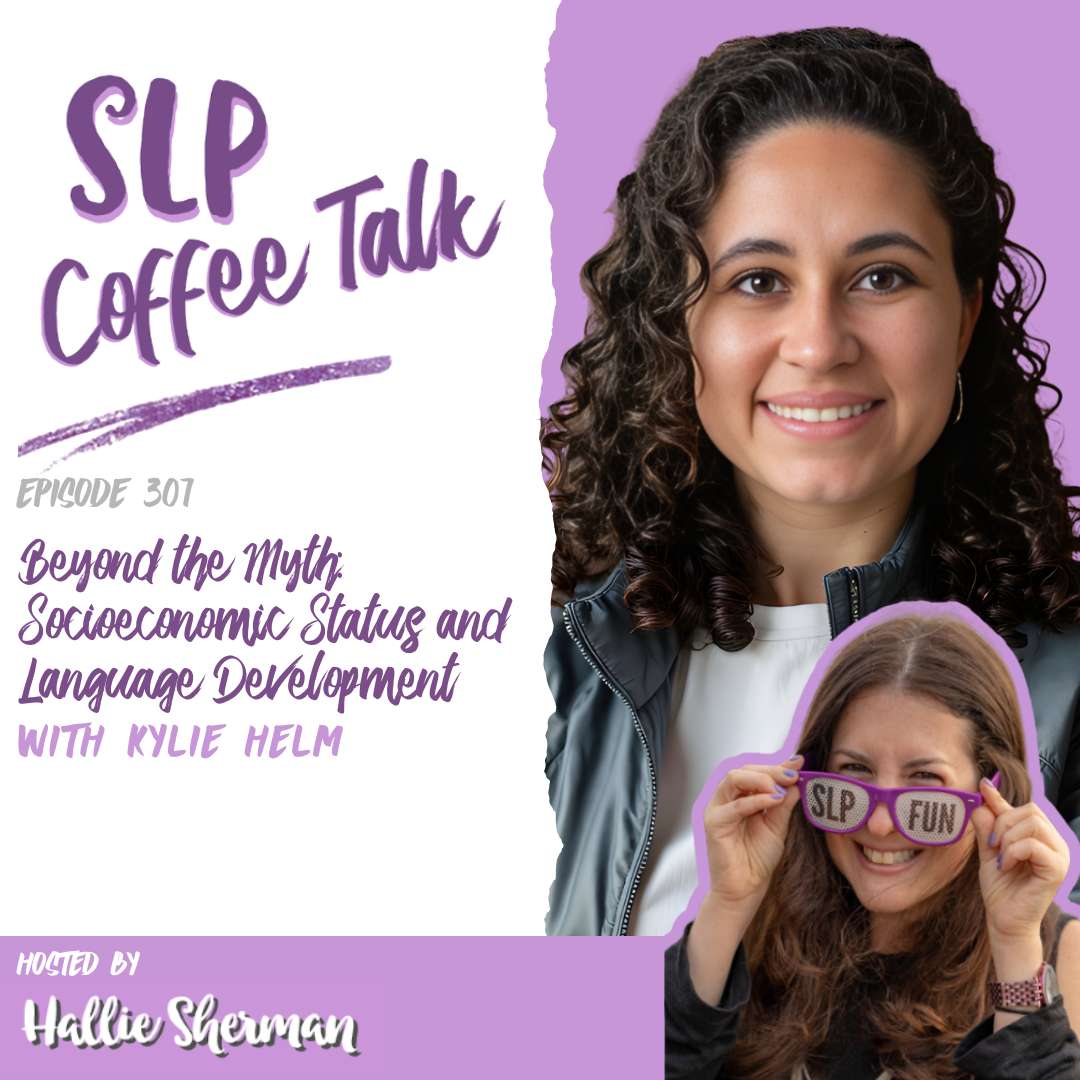
307: Beyond the Myth: Socioeconomic Status and Language Development
Show Notes:
In this episode of SLP Coffee Talk, Hallie sits down with Kylie Helm, school SLP, private practice owner, and PhD student, who’s doing the research we all desperately need. Kylie shares how growing up low-SES herself and then working in a Title I school opened her eyes to the massive disconnect between what grad school teaches us and what these kids actually need. She gets real about the dangerous assumptions SLPs make (spoiler: poverty ≠ language disorder), why standardized vocabulary tests are basically useless for this population, and how syntax is actually the diagnostic hero we’ve been ignoring. If you’ve ever felt pressured to qualify a student just because they’re from a low-income family or wondered how to write a report that says “they bombed the test but don’t need services,” this conversation is packed with research-backed truth bombs and practical ways to do better.
Here's what we learned:
- Stop assuming multilingual + immigrant + low-SES + busy parents = needs speech therapy.
- Syntax is ability-based, vocabulary is environment-based, and that changes everything about diagnosis.
- Dynamic assessment (test-teach-retest) shows learning ability, not just current knowledge.
- Strong syntax + weak vocabulary? Probably environmental. Weak syntax + weak vocabulary? Now we’re concerned.
- Teachers need to step outside their comfort zone too – it’s not all on us to adapt.
RESOURCES
📘✨ Grab your copy of The Secondary SLP Roadmap here! https://www.speechtimefunpd.com/stf-book
Learn more about Kylie Helm:
- Instagram: https://www.instagram.com/kylietheslp
- Study: https://pubs.asha.org/doi/abs/10.1044/2024_PERSP-23-00299
- Developing Cross-Cultural Competence
Learn more about Hallie Sherman and SLP Elevate:
JOKE OF THE WEEK:
Q: Did you get that joke about the ceiling?
A: Me neither. I guess it was over my head.

Where We Can Connect:
- Subscribe to the Podcast
- Follow Hallie on Instagram
- Follow Hallie on Facebook
- Follow Hallie on Pinterest
Subscribe & Review on Apple Podcasts
Are you subscribed to the podcast? If you’re not, I want to encourage you to subscribe today so you don’t miss any future episodes! I already have so many amazing guests and topics lined up, I would hate for you to miss a single one! Click here to subscribe on Apple Podcasts.
Could I ask a big favor? If you are loving the podcast, I would LOVE it if you would leave me a review on Apple Podcasts. I read each and every review. Plus, you get to pay it forward because it will allow other teachers like you to find the podcast! Wondering how to leave a review? Click here to review, then select “Ratings and Reviews” and “Write a Review”. So easy and so appreciated!
Do you have a question you would like me to answer on the podcast?
GREAT! CLICK HERE TO FILL OUT THE FORM!
TRANSCRIPT
00:00:00 Hallie: Hey there SLP friends, is Hallie here, pumping in with the best news ever. My new book, Secondary SLP Roadmap is officially available. If you've ever wished for a clear, practical guide for working with middle and high school students, this is it. It is packed with real stories, ready to use strategies and tools you can use right away. Grab your copy now, check the link in the show notes or search Secondary SLP Roadmap on Amazon. And then of course, please do me a favor. When you are reading it, snap a picture and tag me on Instagram at speechtimefun. I love seeing where you're diving in. The speech room, the couch, waiting in a doctor's waiting room, all the places. All right, ready? Go grab your copy and let's make secondary speech feel doable and fun.
00:00:56 Hallie: Welcome to SLP Coffee Talk, the podcast designed exclusively for speech language pathologists who work with older students, grades 4 through 12. I am your host, Hallie Sherman, your SLP behind Speech Time Fun, the Speech Retreat Conference, and the SLP Elevate Membership. And I'm thrilled to bring you conversations, strategies, and insights that will give you the jolt of inspiration that you need. Whether you're tuning in during your morning commute, on a break in between sessions, or even during a well-deserved relaxation time. I am here for you each and every week. Let's do this SLPs.
00:01:37 Hallie: Hey, hey, and welcome to another episode of SLP Coffee Talk. Today I have Kylie Helm here today, and I know you guys are gonna love our conversation we're gonna be having here today. So, Kylie, welcome to the show.
00:01:49 Kylie: Thank you so much for having me. I'm so excited to be here.
00:01:53 Hallie: Tell everyone listening a little bit more about yourself and your journey to what you are doing today.
00:01:59 Kylie: Yeah, so I started off as a school SLP. I'm actually still school SLP, but that was the journey that I started on. So that was back in 2016. And then in 2018, I started my own private practice just to see if I could, as a nice side hustle. And then in 2020, of all things, I decided I should go back for my PhD. So I am in the child language doctoral program at the University of Kansas. And I am hopefully, very hopefully in my last year of that.
00:02:35 Kylie: And what I've been studying as a PhD student is language acquisition and low socioeconomic communities. And so that's really been my passion and what I've learned and what I'm learning is that it's actually just, it's a huge community and it encompasses a lot of sub communities when we're studying socioeconomic status. So what I've really gotten into is better understanding differential diagnosis between language disorders and language differences when kids are from low SES backgrounds and also trying to be culturally responsive to these kids as we are trying to diagnose them and provide them services because SES encompasses multilingualism, multiculturalism, multiraces, it's the whole gambit. So that's pretty much where my passion lies right now.
00:03:33 Hallie: That's so amazing. And how did you decide what to focus on in your doctoral program?
00:03:38 Kylie: Yeah, for me, it's just personal. So I came from a low socioeconomic background, first generation college student raised by a single mother. And I started working in a Title I school district is what my first job was. And I just felt just so inherent to me to know what the needs were of those kids that were coming across my caseload or the referrals. But it was not so obvious to my colleagues and teachers what the needs were.
00:04:08 Kylie: And so I thought, there's a disconnect somewhere in there of what we're being told as soon to be therapists in grad school and what teachers are being told as soon to be teachers. Just really wasn't realistic for the population that we were serving. And so I thought, I think I'm going to go back and figure out why we have so many misconceptions or why we have not… the best avenues of treatment for these kids. And that's what got me into this line of research.
00:04:40 Hallie: Let's talk about some of these misconceptions. What are some of them that you feel that SOPs listening should be aware of?
00:04:46 Kylie: Yeah, the biggest one is the assumption that every kid from low socioeconomic background has bad language in terms of that they're automatically going to have poor vocabulary or just the assumption that like, oh, yeah, they have a wild home life. They likely need our services. That's just not true. It's not true. And that comes with a lot of assumptions with a lot of different cultures. And then if you tack on like the low SES on top of it, I think SLPs have a lot of assumptions that like, oh, they're multilingual, they're immigrants, they're low SES, their parents work all the time, they're not getting read to at home. All of those things just lead to like, yeah, they're probably gonna need our services, but it's just simply not true.
00:05:35 Hallie: So what are some things they should be looking for instead?
00:05:38 Kylie: I think… differential diagnosis in this community is really hard to do because every single kid is unique in their own needs. And for one, I mean, if we just start with the baseline that every kid is low SES, and take out all the cultures, all things being equal, everyone just is technically impoverished. There's a lot more literature coming out now about better understanding that language is multi-dimensional. It is not just vocabulary. It is not just syntax. But we should really be looking at language as a whole.
00:06:19 Kylie: And so when we get back those scores on that standardized test and it's like… their expressive language is 75. We should look a little bit deeper into that to think about, what else is going on in there? And so I think that's one of the bigger things that I like to stress to SLPs who are examining kids from low SES in general, just being able to dig a little bit deeper into their language and look more at the whole picture and not just that one standardized score that we get.
00:06:53 Hallie: Let's dive a little deeper into just using standardized scores. What else should SLPs be using or doing so that they can get a better picture than using standardized scores, which might not be normed?
00:07:12 Kylie: So you shouldn't be using vocabulary standardized scores at this point. I mean, I know I'm a school SLP. I know you have to sometimes. Your states require you to get those two comprehensive scores and you got to do what you got to do. But I don't think we should be really using that as like our straight up diagnostic piece. Instead, I love language samples and I know that's a little bit polarizing because when you're in grad school, you're like, just give me the score. Like, I don't want to sift through all of these utterances. I don't want to look at all of this and figure out what's going on.
00:07:46 Kylie: But honestly, that is where the gold lies in understanding what a child's language is. So I always say we should be looking for obligatory syntax. So that would be looking at irregular and regular past tense, the use of auxiliaries, the use of auxiliary both in be and in do, making sure that those morphemes are there at the end of our words, those little teeny tiny pieces of language that sometimes we just like to glide over are the ones that tell us the most information about what these kids are doing and what they're not doing.
00:08:27 Kylie: So I always say the language samples and then of course, dynamic assessment is a great avenue. There's lots of different types and there's a lot of different research on what kind to use. I love using tests and retests. Tests-teach-retests. I love doing that because I think it's really telling, it tells you a lot about the learning ability of a child. And then also if they have that skill, they're gonna learn it after you teach it to them. Those are some of the big pieces that I always encourage SLPs use.
00:08:58 Hallie: I love that. What would you recommend for SLPs when teachers are coming to them saying, I'm concerned and how should the SLPs respond and what things should they be asking the teachers about to get more information?
00:09:12 Kylie: Yeah. One of the big things that I always talk about is are we looking at their functional communication or are we looking at their academic communication? So if we're asking about their functional communication, are they able to communicate their basic wants and needs? Do you know on the regular like where they’re at? Can they tell you they need to go to the bathroom? When they tell you that what does that sound like? Is it like broken up and there's no syntax there, there’s no grammar there? Or is it like a complete sentence? Are you able to clearly understand their wants and needs?
00:09:51 Hallie: Versus like… or is the concern more about like when we're getting into like a writing task, a written expression task, and they're missing pieces of that. And that can get kind of into more complex syntax, which sometimes when kids are not exposed to academic work early in life, they didn't get to go to preschool. And most of my population does not get to go to preschool because preschool is extra in America. They cannot afford it. And I think like, oh, I think it's good to just do the test, teach, retest, model for the teacher. Try that kind of strategy, see if they can model after you and just see if they can do like that higher level task without the pullout and the interventions from me. And then we can kind of go from there. So I kind of go back to like, are they functional with their communication or is this more of an academic task and kind of go from there?
00:10:45 H :Love it. Thank you so much. And I know you did a thorough research study comparing these students with… compared to their peers. What are some findings that you found that SLPs should be aware of?
00:11:00 Kylie: Yeah, the systematic review. One of the biggest findings that came out of that review with my colleague Claire Selin, Dr. Claire Selin, is that when we're doing differential diagnosis for children from low SCS backgrounds, typically, all kids across the board, low, mid, or high SES, when we're looking at their syntax, basic syntax have very comparable skills. And then if we're looking at vocabulary, on the other hand, there tends to be a gradient effect in which children from higher SES backgrounds tend to have more vocabulary skills than the kids from the lower SES background.
00:11:43 Kylie: One of the big things that came out of that is that when we're looking at differential diagnosis, we should really pay attention to the syntax piece of these assessments that we're giving kids from low SES. So if we just kind of assume that, okay, they're low SES, they have low vocabulary, that doesn't really tell us anything at this point. They tend to bomb those tests. They're not made for them. And so that's not very helpful. It's not diagnostic information for us.
00:12:12 Kylie: So if they have low vocabulary, but within normal limits or high syntax, I say it's okay probably to just kind of wait a minute and see if we can get the vocabulary up to speed. There's been a lot of literature that shows that syntax is a little bit more ability-based and vocabulary is a little bit more environment-based. So if a kid from low SES background has good syntax, then there's a good chance that their language ability is there and is functional.
00:12:42 Kylie: On the other hand, one of the considerations that we said was perhaps if a child from low SES has below average vocabulary skills and also below average syntax skills, then that might set off some alarm bells for like, okay, this is a kid that we need to dive a little bit deeper into because that syntax ability level is low too. And that might just be a little bit more of an indicator that this is a true language impairment.
00:13:09 Hallie: So fascinating, so interesting. Thank you so much. I'm going to say, ask those students also that are bilingual, you're assessing in their native language and doing testing in both languages to determine their syntax abilities.
00:13:23 Kylie: Yeah, definitely. Definitely. I do think there is some truth in the idea that when we're looking at syntax, like if their syntax is impaired in one language and it's impaired in the other language, then yes, we should be more concerned about language impairment. I don't share those same sentiments with vocabulary because learning vocabulary words is… it never ends. We learn vocabulary skills our whole life and you're trying to learn it in two different language at a young age. Eh, that's very difficult to do.
00:13:54 Hallie: I'm sure many listening are wondering, well, how do I report that in a report that they poorly on the vocabulary section, however, that's not indicative of a language disorder. It might be just the difference or whatever, how can they report that in a way that is clear and appropriate?
00:14:13 Kylie: Yeah, that's a great question. And I should say I should just preference, like I don't have all the answers in this area. So everybody has their own policies and ways that they have to follow, kind of like a flow chart if they do this and you got to say X, if they do that and you got to say why. But honestly, the way I handle situations is I'm just very frank in my writing about it. I will draw in, like, based on the literature, this child has… these risk factors for this test not being an accurate representation of their language ability. Those risk factors may be coming from a low socioeconomic environment. It could be that they're multilingual. It could be that they're immigrants, and maybe they just experience the huge life stressor or trauma by coming over to a brand new country and leaving everything they knew.
00:15:04 Kylie: So I'm just frank in my findings. Everybody gets a chance to say what their observations are, you know, that subjective part of the assessment. And I just put mine in there. And then I will just say my recommendations, like based on these risk factors at this time language therapy does not seem appropriate. And I was throw in something about being culturally responsive. And I haven't really gotten any pushback on that yet.
00:15:34 Hallie: That's a good thing. I just know that… I've worked in districts and things where they were told to report scores. And sometimes that just doesn't tell the whole picture. So being able to… that's the benefit of a report is having that opportunity to dive a little deeper into what is going on more than just.
00:15:56 Kylie: Yeah, exactly.
00:15:58 Hallie: If people wanted to learn more about diving deeper into this topic, what are some resources and tools out there for those wanting to learn more?
00:16:07 Kylie: That’s a great question. I feel like… there's tons of research on language acquisition and socioeconomic status. Like, nobody can argue that that's been going on for decades now. I do feel like a lot of the older literature around that is not really examined in a way that is culturally responsive. And so a lot of places that I turn to is… it is this book called Developing Cross-Cultural Competence. And so that's really helpful for me when I'm thinking about – and I will send it to you so you can print it if you want. Yes, it is by Eleanor Lynch and Marci Hanson.
00:16:50 Kylie: And that's a great resource when we're just thinking about how to be culturally responsive in this area of our practice and just thinking about… how could this kid coming from a different culture, how could his culture be impacting his language ability or his testing ability or his ability to participate in the classroom and this is why all the teacher has some concerns? So I love that. It gives very practical resources and explanations about very specific cultures. So that's usually my go-to, especially when teachers approach you in the hall and they have all these concerns and I'll say, like here is what like this is what's normal in this kid's culture. And so maybe this is why you're experiencing some of these disconnects. So that's one of the bigger ones that I turn to.
00:17:44 Kylie: That's awesome. And that's so helpful, especially like you mentioned earlier, like here are some sidebar, okay, let's wait and see. Here are some future strategies that they can do. It doesn't mean it needs intervention by us at this time.
00:17:57 Kylie: Exactly. Right. And challenging them to think about their classroom outside of what it's always been for the last 30 years. Like immigration is huge. I mean, people are more transient than they have ever been. And so I think it's also part of our job. We're outside of our comfort zone a lot of the time and it's part of our job to encourage our colleagues and teachers to also kind of step out a little bit and to take some of the responsibility for serving these kids as well.
00:18:27 Hallie: Thank you so, so much. Where can everyone learn more about you and learning more from you?
00:18;33 Kylie: Yeah, you can follow me on Instagram @kylietheslp. That's where most of my info is disseminated. Yeah, that's where I'll be.
00:18:44 Hallie: Awesome. Well, thank you so, so much, Kylie. I always end my episodes with a joke, since jokes build rapport, language-based, and they're a lot of fun. So, okay. Did you get that joke about the ceiling?
00:18:58 Kylie: No.
00:18:59 Hallie: Me neither. I guess it was over my head.
00:19:04 Kylie: Nailed it.
00;19:05 Hallie: Nailed it, guys. Again, as I say always, if you want to use it, you can. If your students like it, you can take credit for it. I don't mind. I just find these on Google. So I didn't make it up anyway. So I'm not that creative. Thank you, Kylie, so so much. This was so informative, so helpful. This is one of those episodes, guys, you can refresh, listen to again when you need to. Share this episode with your colleagues if they don't believe you. Here is your proof of, you're not making this up. This is real true facts. So thank you, Kelly, so, so much. And until next week, everyone, stay out of trouble.
00:19:46 Hallie: Thanks so much for tuning in to another episode of SLP Coffee Talk. It means the world to me that you're tuning in each and every week and getting the jolt of inspiration you need. You can find all of the links and information mentioned in this episode at my website, speechtimefun.com. Don't forget to follow the show so you don't miss any future episodes. And while you're there, It would mean the world to me if you would take a few seconds and leave me an honest review. See you next week with another episode full of fun and inspiration from one SLP to another. Have fun guys.