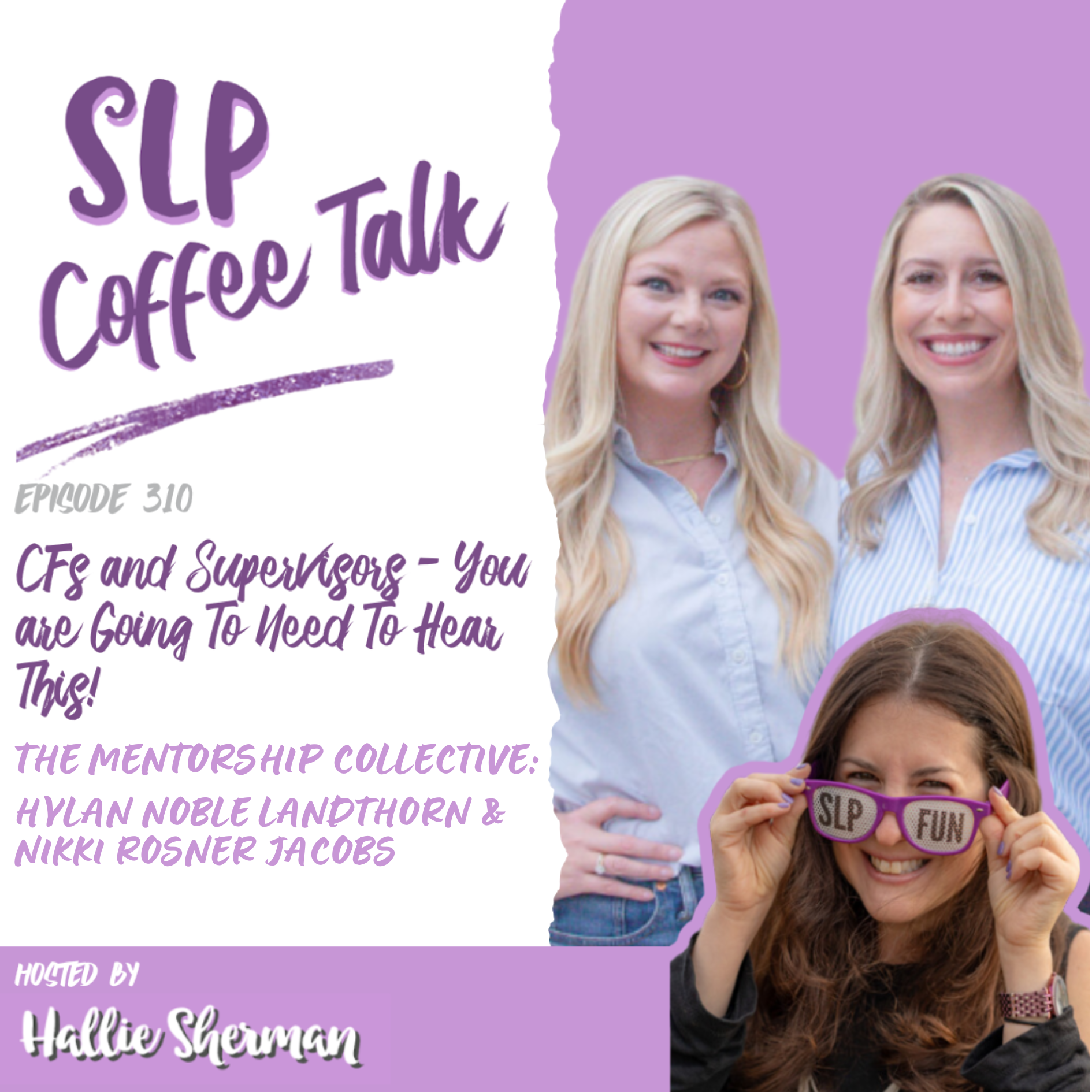
310: CFs and Supervisors – You are Going to Need to Hear This!
Show Notes:
Get ready for an inspiring conversation with Hylan Noble Landthorn and Nikki Rosner Jacobs, the powerhouse duo behind The Mentorship Collective! With over 24 years of combined experience as speech and language pathologists, they’re on a mission to support and empower the next generation of SLPs.
As the founders of WordsMyWay, a play-based, child-led speech therapy practice, Hylan and Nikki believe in connection, creativity, and personalized care. After years of mentoring clinicians through fellowships and daily practice, they saw the need for deeper support—and that’s how The Mentorship Collective was born.
In this episode, they share how they’re redefining mentorship to help new SLPs grow with confidence, professionalism, and purpose—so they don’t just survive their fellowships, but truly thrive.
Here's what we learned:
- Grad school teaches theory, but CFs need help translating it into flexible, real-time decision-making
- Supervision ≠ mentorship; CFs need space for questions, reflection, and growth
- Confidence grows through guided problem-solving, not having all the answers
- Strong mentorship reduces stress, overwhelm, and early burnout
- An open, growth-oriented mindset helps CFs learn faster and thrive long-term
RESOURCES
📘✨ Grab your copy of The Secondary SLP Roadmap here! https://www.speechtimefunpd.com/stf-book
Learn more about The Mentorship Collective: Hylan Noble Landthorn & Nikki Rosner Jacobs:
Learn more about Hallie Sherman and SLP Elevate:
JOKE OF THE WEEK:
Q: What do call a tired tent?
A: A sleepy teepee.


Where We Can Connect:
- Subscribe to the Podcast
- Follow Hallie on Instagram
- Follow Hallie on Facebook
- Follow Hallie on Pinterest
Subscribe & Review on Apple Podcasts
Are you subscribed to the podcast? If you’re not, I want to encourage you to subscribe today so you don’t miss any future episodes! I already have so many amazing guests and topics lined up, I would hate for you to miss a single one! Click here to subscribe on Apple Podcasts.
Could I ask a big favor? If you are loving the podcast, I would LOVE it if you would leave me a review on Apple Podcasts. I read each and every review. Plus, you get to pay it forward because it will allow other teachers like you to find the podcast! Wondering how to leave a review? Click here to review, then select “Ratings and Reviews” and “Write a Review”. So easy and so appreciated!
Do you have a question you would like me to answer on the podcast?
GREAT! CLICK HERE TO FILL OUT THE FORM!
TRANSCRIPT
00:00:00 Hallie: Hey there SLP friends, is Hallie here, popping in with the best news ever. My new book, Secondary SLP Roadmap is officially available. If you've ever wished for a clear, practical guide for working with middle and high school students, this is it. It is packed with real stories, ready to use strategies and tools you can use right away. Grab your copy now. Check the link in the show notes or search Secondary SLP Roadmap on Amazon. And then of course, please do me a favor. When you are reading it, snap a picture and tag me on Instagram @speechtimefun. I love seeing where you're diving in. The speech room, the couch, waiting in a doctor's waiting room, all the places. All right, ready? Go grab your copy and let's make secondary speech feel doable and fun.
00:00:58 Hallie: Welcome to SLP Coffee Talk, the podcast designed exclusively for speech language pathologists who work with older students, grades four through 12. I am your host, Hallie Sherman, your SLP behind Speech Time Fun, the Speech Retreat Conference, and the SLP Elevate Membership. And I'm thrilled to bring you conversations, strategies, and insights that will give you the jolt of inspiration that you need. Whether you're tuning in during your morning commute, on a break in between sessions, or even during a well-deserved relaxation time. I am here for you each and every week. Let's do this SLPs.
00:01:39 Hallie: Hey, hey, and welcome to another episode of SLP Coffee Talk. Are you a new SLP? An SLP that can use some little extra help? ACF? Maybe you're a supervisor and needing help on knowing how to do that? I know you guys are gonna love my guests, plural, here today. Hi guys, welcome to the show.
00:02:02 Hylan/Nikki: Hi. Hello, thank you for having us.
00:02:04 Hallie: I have the Mentorship Collective here, the two, the duo. Why don't you guys introduce yourselves to everyone listening?
00:02:11 Hylan: We are happy to do it. So we are the mentorship collective. I am Hyland and this is Nikki. I'll tell you a little bit about me and then I'll turn it over to Nikki. But yeah, we are so excited to be here, Hallie. Thank you so much for having us and we love your page. We love following you and we love how you support SLPs. And that is our goal as well for the Mentorship Collective is we truly love and are so passionate about helping any career level of an SLP, whether you be a clinical fellow, a new grad, a graduate student, you're going into a leadership role, maybe you're opening up your own company and you're hiring therapists and you're wanting to build a mentorship system there. In supporting therapists become their best therapist self essentially and helping them grow and providing education and supports to how to help you be successful, decrease burnout and just keep you in our field because we need you. So we're really excited to be here.
00:03:05 Hylan: I met Nikki many years ago in San Diego. I currently live in San Diego and we also own our own private practice as well, in addition to the Mentorship Collective. And I was very fortunate enough to work with Nikki for many years and then our path kind of grew from there. So I'll kind of turn it over to Nikki to give some info about that.
00:03:24 NIkki: Yeah, the way that we ended up creating the mentorship collective is, Hylan and I actually helped open a practice and we grew that practice from just the two of us to over 24 clinicians across two states. And that was over a six year span. So it was very exciting. We had as clinical fellows at one time that started over a period of three months. And from that, we realized what supports were working, what needed to be adjusted and what was really helping our clinical fellows thrive. And all of their friends kept asking like, maybe Nikki and Hylan could teach us. Maybe we need a Nikki and a Hylan to help us get to that next level for our past our CF and really feel confident walking into their first years. And that's where Hylan and I had dreamed of creating this company.
00:04:09 NIkki: And that's where we really learned a lot about mentorship and how to help support new grads, how to help support mentors support new grads. And that's where everything kind of grew. And now we are really working through helping clinical fellows. We're working one-on-one with clinical fellows who have elected to work with us, as well as a mentorship program that Hylan stated that we are working with a company to input their own mentorship program in their private practice. So it's very, very exciting.
00:04:40 Hallie: I love that. I've never had my own CF working with me. I've only worked with grad students, but I've definitely noticed over the years, the graduate students I worked with were leaving, I don't want to say less confident. It was just a different readiness or like, and had nothing to do with me and then nothing. I was just, what have you guys seen over the years?
00:05:03 NIkki: We talk about this a lot. The transfer of theory to actual clinical work can be very difficult. And now we have this entire system where we Google and we use the internet. And so it kind of stops the critical thinking piece of learning what goes right and what goes wrong and what to do when things go wrong. So we find a lot of clinical fellows who come and they start just don't know how to look at a child and see where they're having difficulty and how to get to that next level. And those are the pieces that really create the foundations for being a therapist.
00:05:37 NIkki: No one's ever gonna know everything. None of us know everything. I think all three of us can confidently say we go into sessions like, that was a tricky one. What am I gonna do next? And so that critical thinking piece can be really difficult to go from what the theory of what we want to do for treatment is to when that doesn't work. What do you do when the thing you taught, you were taught in grad school doesn't work the way in the real world? And what's the next step there too?
00:06:05 Hylan: We found that like there's a lot of black and white thinking still. And a lot of what we do in pediatrics, as you know, is in the gray because it's individualized for every child. And so there's not a textbook or a specific experience that can help guide you in what you do. You just have to understand those clinical reasoning skills, like Nikki said. And so that's why we have created programs to provide all of those challenges or to challenge clinical fellows in that way to help support their thinking, regardless of what child they're working with, age, diagnosis. It doesn't matter if you understand how to approach a child and to think critically and to think flexibly, then you can be successful with any client. And that's something that grad school, even if you had the best supervisors in the country, I help support a graduate program as well and do my best to help graduate students.
00:06:56 Hylan: But it's just, it comes with experience and it comes with more mentorship and more support in your clinical fellowship and beyond. And unfortunately we don't have access to that. Or oftentimes when people go into their clinical fellowship, their supervisor could be wonderful, but they have limited time to support them because of their own restrictions, as you know, and the requirements for them. And so that's where we want to provide that supplemental, kind of fill that gap in that piece to give them the guidance, the critical thinking skills, and essentially a roadmap to be successful. Because we're finding that that's where a lot of SLPs or younger SLPs are getting very burnt out and very stressed and thinking, I don't know if this career is for me. And if you feel confident in your clinical skills, then you can handle all the other stuff that's thrown at you but you've got to feel confident in your clinical skills first.
00:07:45 Hallie: I would love your advice even for like grad supervisors that are working with these grad students that are about to embark on the world. What things can they make sure they are trying to do more of or less of to help these grad students enter into the SLP world feeling confident?
00:08:04 NIkki: I love that question. I think that would be a wonderful shift to kind of think about instead of planning lessons or maybe there is a plan and now all of a sudden the plan has changed right before a session. And what does that graduate student do when their plan that they had had no longer is able to be used in a session? Because we know that as therapists, planning is something that you can do in your brain, but you have to be so flexible if you walk in, because most of our plans don't go to plan.
00:08:34 NIkki: And we have to be able to support the child. And I think that grad school does a great job of teaching how to look at structure within a session. But what do you do when that structure doesn't work? How do you change it? So if they have them go in with no toys, what do you do? How do you work without any flashcards? What do you do when the toy that you had is broken?
00:08:56 Hallie: It's not working.
00:08:58 NIkki: Yeah.
00:08:59 Hallie: The photocopying machine's broken. Like all of the things that really could go down.
00:09:02 NIkki: Yep. And how do we work through that feeling for that child who was upset, who wanted to maybe play with something that turned on and it doesn't. And those are the pieces that are going to help you learn how to adjust without panicking in the real world. Because that's a real world thing where you walk into a session and we figure out how to support the child without all of that additional time and planning. And that doesn't translate. So that would be my recommendation is to change the plan right before the session and help them understand how to do this without panicking.
00:09:36 Hallie: I love that. I know people that I've spoken to have a hard time realizing that the CF is still a job. Because they go from grad school where they have a supervisor to their CF where they have a supervisor. But this time it's like you're actually though employed. I was still expected to know and do and go and have these job expectations. What would you say to someone listening who is, know, because we have a lot of new grads that graduated in December who are starting their CFs right now that are feeling like, oh my goodness, I'm not ready to work or like, I need someone right next to my side this whole time. Like, what would you say to that person if they were right in front of you?
00:10:22 Hylan: I would tell them that it starts with your mindset and having an open mindset versus a closed mindset. That's the number one recommendation that we try to to train SLPs on is being open to the fact that you're not going to know everything. You are going to make mistakes Mistakes and being uncomfortable is how we grow. Pressure makes diamonds, right? And know going into this that it is going to be hard and you are going to be okay. And that is why we have created a space to also provide that supplemental support. Mentorship, we have one-to-one mentorship trainings and we have an entire program and roadmap dedicated to providing this advice.
00:11:00 Hylan: Because not only is it important for you to be open minded to the advice and feedback of your supervisor and understand their communication style and your communication style and know that you are not going to know everything, nor should you know everything, but it's also important to learn the soft skills. So being able to collaborate with your fellow SLPs, knowing how to ask questions, knowing how to show up and just showing up, knowing that sometimes that is all you can give is just being there that day, getting out of bed and showing up and having fun with your clients.
00:11:36 Hylan: If you are having fun with your clients, if you are engaging and you are prioritizing connection and engagement, and you are prioritizing having an open mindset and open conversations and open to receiving that gift of feedback, because we believe that feedback is truly a gift. You have to have that to grow then you are going to be fine. And it is scary, it is hard, but anything scary, anything hard usually means it's worth it because those are the things in life that challenge us and make us better.
00:12:05 Hylan: And I always tell new grads, think of all of the thousands and thousands and thousands of SLPs before you that got through this time and have now found our niches and are thriving in this career and we wouldn't do anything else. However, we did have to go through some times that were difficult, but you don't have to do it alone. You now are in an age where you have access to so much great support, including your page, Hallie. So many of us wanting to help you thrive. so open mindset, showing up, having that positive outlook and reaching out to your resources for assistance.
00:12:41 Hylan: You know, I also tell people this, that it's you have a choice every day. You can choose to gain access to support or you can choose to buy more coffee or you can choose. Or both. Exactly. Or both. But you have a choice because it's out there. You know, when we were doing our clinical fellowships and when we were early career SLPs, we did not have the access to all of the support that our new grads have now. So make your life easier. Access the support. Invest in yourself. You are your greatest investment. And we can all probably attest to this too, no one else is going to invest in you. They're just not. They might say they are. They might say that they're going to invest in you and give you access to CEUs and all these things.
00:13:24 Hylan: Nine times out of 10, that doesn't always work out. You have to take care of yourself. So, you know, we really encourage grad students in those ways to be just open to all of the support and really take advantage of it and know that this world needs you. There's such a spot for you.
00:13:40 Hallie: Love that. I love that. The proof is there. There's so many people in. Yes, it's so true. And you have to advocate for yourself because no one else will. What would you say to someone who is worried that their colleagues, admin, parents that they're working with will see right through them? Like, oh, they don't know what they're talking about kind of thing.
00:14:00 NIkki: I think that they I would tell them to pause and to really look at the facts. Is that something that they are finding they're getting feedback? Someone's providing that feedback to them. And if so, what are the facts? What is that person actually saying versus what the narrative they've created in their brain is as well? Because we do have a habit of creating lots of narratives of what's going well, what's not going well. And it's typically centered on us. What is our piece as the main character in our plot lines? And oftentimes what we can do is pause when we're feeling that and instead shift our focus to the child.
00:14:33 NIkki: What does the child need? What's the child missing? What do I feel like I need to do to adjust for the child? By taking the focus away from ourselves and starting to focus on the child, it's going to give you a mission. And that's really where our focus is going to be best served. And so I think if you're feeling that you're feeling it's shaky with your admin team, it's shaky with the parents, they might know that you are a newer clinician. You don't need to tell them you're a newer clinician. That's something that we see a lot is, well, I'm a new clinician. You don't need to divest that information, there's no reason to state that because what you are is a brand new clinician who came out ready to work and ready to help these children.
00:15:11 NIkki: So what are you going to do versus thinking about all of the things that you're unable to do? It's really like Hylan said, it's a mindset shift. The more that you think about, I'm nervous, I'm not ready for this, someone else can do it better. You're going to find instances that prove that. Whereas if you prove I'm here, I went to grad school, I'm ready to learn, I'm asking questions and I want to help these kids, you're going to find facts that help you prove that you are there and you are meant to be an SLP.
00:15:39 Hallie: And I was asked for like a whole pass, like five years into my career. like I still look like I was a new clinician. I whatever. But also even like I was questioned by people that were not SLP. And I had to stand up for myself and say, like, yes, you might have more experience as a teacher but you're not an SLP. I am one. And so like…
00:16:01 NIkki: Yeah, I love that and thinking about it's not about experience level, right? Sometimes what it is is what is it that you're here to help support? As their SLP, I'm here to support this child in all of these ways. This is my goal and this is how I want to help collaborate with you.
00:16:19 Hallie: Can you share like a win or a success story with someone that you've worked with that someone maybe came in unsure of themselves and blossomed?
00:16:29 Hylan: Yeah, so we actually have several that we would love to share. So we have worked with many clinical fellows throughout the years and one of them came in, I'll kind of share one about one specifically that I worked a little bit more closely with. She came in terrified. She was wanting to know all of the info. She was wanting me to teach her from day one exactly what to do with every child, every diagnosis. And that is natural, right? That's how we feel as a clinical fellow is,
just tell me what to do versus helping me with critical thinking.
00:17:00 Hylan: And by the time she finished her clinical fellowship, she was able to confidently work with any child, any age, any diagnosis. She felt like she had the critical thinking skills to be able to support any family, parent coaching. And now she is actively running an entire therapy department. Yeah, and she's supporting OTs, PTs, and SLPs. And because of, she still attributes her success to us and our mentorship supporting her in her clinical fellowship because she felt so confident post her clinical fellowship with her clinical skills that she continued to thrive in other areas of the speech language pathology world. She became a specialist in different areas and then she was able to take on her own CF and now is helping run an entire rehabilitation department.
00:17:48 Hylan: And so we are so proud of that. That's one of many stories that we are so proud of that we could share. I know Nikki could probably share some as well, but to go from being a clinical fellow who was so nervous and scared and we were able to provide her with the support that we were able to provide and all of the clinical fellows who were interested and provide that roadmap and give them those tools and that advice to now she's managing a department. It just means a lot to us to see that significant change in confidence in that success.
00:18:20 Hallie: That's so amazing. Is there any last bit of advice you would give to someone listening that is entering in their CF or in the middle of their CF and wondering if they can survive their CF or those that are
mentoring grad students or CS for any advice that you give to someone who's feeling like they need some help.
00:18:36 NIkki: Yeah, I think I would really pause and try to look inward at what is it that you need support with? What are the things that are so important for you to be able to find your value within our field? And how do you get that support? So really getting clear with yourself on what you need to be able to thrive within our career. Because we don't want to just survive, we do want to thrive within it. There are so many wonderful things. And to be able to support our kids, we need to show up excited and motivated and happy. And we need to find a line that doesn't create burnout.
00:19:11 NIkki: So if you are in that space, pause, look inward, and really write down what is it that you need.
to be able to move forward and then find those supports. Reach out to us if you're feeling like, don't even know. We can work with you and help you identify the pain points and with plans you need in place to be able to feel better because it doesn't need to feel like that. And it's understanding is this something that you can physically change and work through within your setting? Is the setting something that fills your soul?
Or is this something that we need to work through? Is this the right setting for you? And if not, what's next? What setting within the speech therapy field?
00:19:52 NIkki: Because we are so lucky within this field to have so many different avenues that really find kind of our niche and figure out what works for us and where we really groove with. Hylan might not, Hylan and are very aligned, but we might find someone who doesn't love pediatrics as much as they really love working with the medical population with adults. And so figuring out, are you aligned with your goals? And if not, how do you get aligned?
00:20:20 Hallie: I love that. Where can everyone learn more about you guys and everything you have to offer?
00:20:25 Hylan: Yes, you can find us on Instagram at Mentorship Collective, as well as TikTok @Mentorship Collective, and then our website mentorshipcollective.com. We actually have several programs that we've also just released that are helpful for all levels of CFs that involve professional development hours. The most recent one is called Pediatric Pathways. And this is a program where we use an entire communication house framework that is unique to us to help you feel confident developing goals and a plan of care and supporting difficult conversations with families. Collaborators for any child, any age, any diagnosis. So you'll find that recently posted on our site as well as access to all of our CF support programs, our leadership and training programs, and our free resources because we do have lots of those.
00:21:12 Hylan: We encourage everyone to also sign up for our email subscriber list because we send out weekly emails as well with therapy tips as well as information on new program releases and just how you can set up even just a meeting with us to chat just to get to know us and to learn like Nikki said more about how we can support you in your career.
00:21:31 Hallie: I love that. Thank you guys so much. We'll have links to everything in the show notes and not to worry. I always end my episodes with a joke since jokes are fun and builds tons of rapport. What do call a tired tent?
00:21:46 Hylan: A tired tent.
00:21:49 NIkki: I have no idea.
00:21:51 Hylan: I don't know.
00:21:52 Hallie: A sleepy teepee.
00:21:53 NIkki: Oh my God. That was a good one.
00:21:58 Hallie: I have like 40 jokes are here every week for you. I have not missed one. Maybe I've repeated a few because there's only so many jokes in the world. Thank you guys so, so much. Go check them out on Instagram. Go check out their website and remember everyone, you're not alone. You are awesome. And until next week, stay out of trouble.
22:24 Hallie: Thanks so much for tuning in to another episode of SLP Coffee Talk. It means the world to me that you're tuning in each and every week and getting the jolt of inspiration you need. You can find all of the links and information mentioned in this episode at my website, speechtimefun.com. Don't forget to follow the show so you don't miss any future episodes. And while you're there, it would mean the world to me. If you would take a few seconds and leave me an honest review. See you next week with another episode full of fun and inspiration from one SLP to another. Have fun guys.
00:23:06 Hallie: Hey there SLP, I have a quick question for you. What if you could have just one book on your shelf that actually gets the challenges of working with middle school and high school students? Well, it's here. Well, actually the pre-order is here, but hey, I'm so excited to let you know that my brand new book, The Secondary SLP Guide is available for pre-order. And when you pre-order, you get an exclusive bonus that you won't want to miss. It is packed with real talk strategies, quick tips and inspiration that you can use with your middle school and high school students or all year long. This is the perfect book for a book club, a grad student group, or just flipping through when you're stuck and in a IEP writing spiral. So head to speechtimefun.com slash pre-order or head to my Instagram and send me a DM with the word pre-order and I will send you the link so you can pre-order now and I cannot wait for you to get your hands on this book in November but the sooner you grab it the better the bonus.