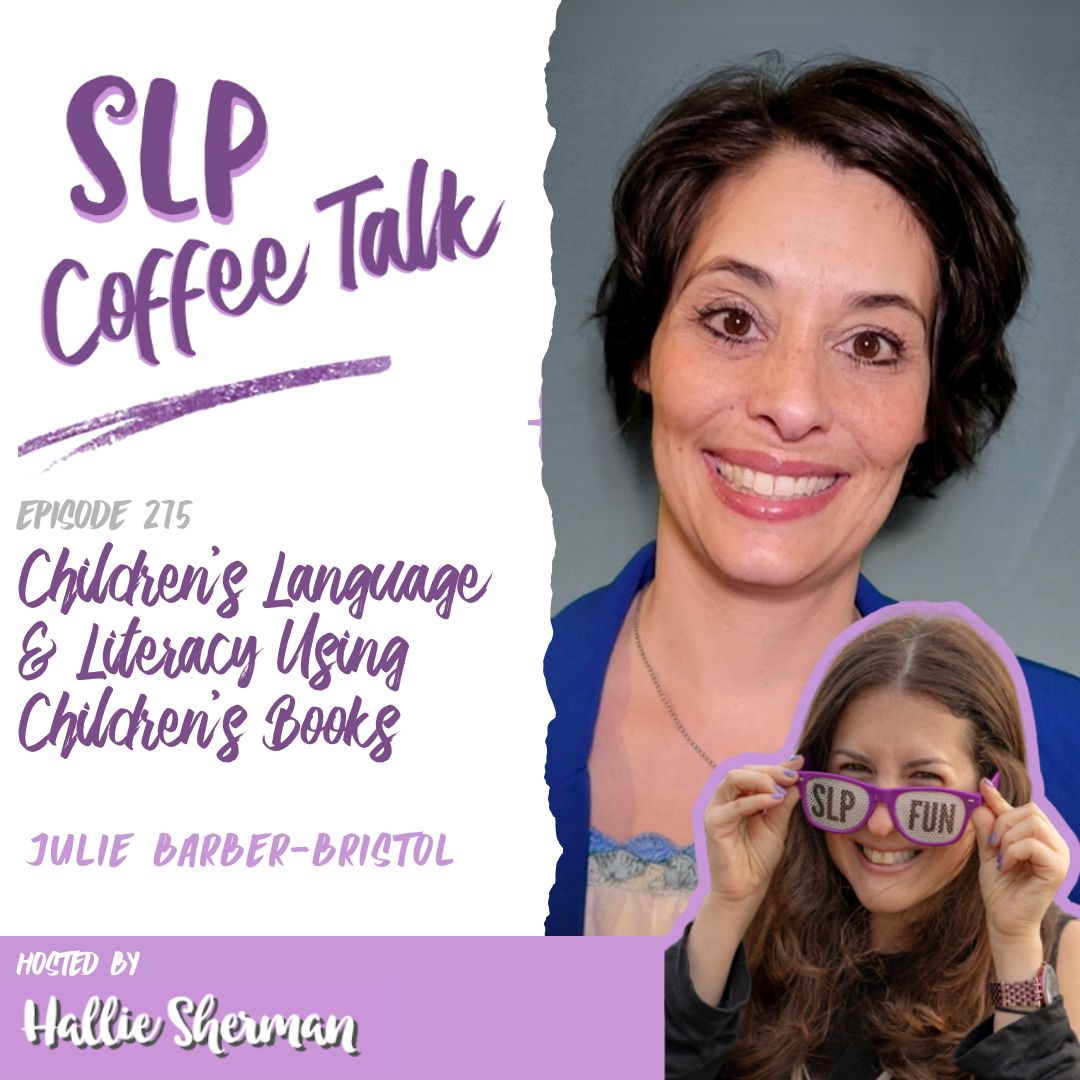
275: Children’s Language and Literacy Using Children’s Books
Show Notes:
In this fun and heartwarming episode of SLP Coffee Talk, we’re hanging out with the fabulous Julie L. Barber-Bristol, M.S., CCC-SLP—a children’s literature-loving SLP with 20+ years of experience and a passion for making speech therapy magical. From New York to Pennsylvania to Texas, Julie’s done it all—private practice, schools, hospitals, even nursing homes. Now rocking it in Cypress-Fairbanks ISD, she shares how she takes just one picture book and spins it into a month-long adventure full of language goals, classroom collabs, and sensory fun! If you love kid lit, creative therapy ideas, and real talk from a seasoned SLP, you’re in for a treat!
Here's what we learned:
- One great book can fuel weeks of creative, effective therapy.
- Books are packed with visuals, vocab, and built-in engagement.
- Collaboration = magic. Don’t go it alone!
- You don’t need fancy materials—just creativity and a good story.
- Social thinking and emotion skills pair perfectly with literacy.
- When therapy is fun, students (and staff!) want to be part of it.
- The speech room isn’t the only place great therapy happens—get out there!
RESOURCES
Learn more about Julie Barber-Bristol:
Email: 4theloveofliteracy1@gmail.com
Instagram: https://www.instagram.com/JulieB2SLP/
X/Twitter: https://x.com/andre_bristol
Favorite Hashtag: #BringLanguageToLife
Learn more about Hallie Sherman and SLP Elevate:
🎧 Check out the Secondary Secret Podcast here!
JOKE OF THE WEEK:
Q: How do you tell that the weather is getting warmer?
A: There's a SPRING in people's steps.

Where We Can Connect:
Subscribe & Review on Apple Podcasts
Are you subscribed to the podcast? If you’re not, I want to encourage you to subscribe today so you don’t miss any future episodes! I already have so many amazing guests and topics lined up, I would hate for you to miss a single one! Click here to subscribe on Apple Podcasts.
Could I ask a big favor? If you are loving the podcast, I would LOVE it if you would leave me a review on Apple Podcasts. I read each and every review. Plus, you get to pay it forward because it will allow other teachers like you to find the podcast! Wondering how to leave a review? Click here to review, then select “Ratings and Reviews” and “Write a Review”. So easy and so appreciated!
Do you have a question you would like me to answer on the podcast?
GREAT! CLICK HERE TO FILL OUT THE FORM!
TRANSCRIPT
00:00:00 Hallie: Hey there, SLP working with grades 4 through 12. New school year, new you. Let's not go into this school year feeling overwhelmed and behind on paperwork. Let's not worry about students asking why they are coming to speech. Let's not have students shrugging their shoulders and looking at you saying, “Why am I here? I don't want to be here.” Let's instead have your students excited to come to speech, ready to take on the challenges you provide, and make massive progress towards their goals.
00:30:00 Hallie: If you are ready to make this school year the year that you leave work promptly at the end of the day, plan in an hour or less a week, and go into every session confident that your students will grasp the session objectives, then SLP Elevate is just what you need to make this school year a successful one. Either go to slpelevate.com or send me a DM on Instagram with the word “club”, C-U-L-B, and we can discuss if SLP Elevate is right for you and your students. Now is the time to get your time back, and now is the time to get your students excited to come to speech. SLP Elevate is perfect for you.
00:01:14 Hallie: Welcome to SLP Coffee Talk, the podcast designed exclusively for speech-language pathologists who work with older students, grades 4 through 12. I am your host, Hallie Sherman, your SLP behind Speech Time Fun, the Speech Retreat Conference, and the SLP Elevate Membership. And I'm thrilled to bring you conversations, strategies, and insights that will give you the jolt of inspiration that you need. Whether you're tuning in during your morning commute, on a break in between sessions, or even during a well-deserved relaxation time, I am here for you each and every week. Let's do this, SLPs.
00:01:55 Hallie: Hey, hey, and welcome to another episode of SLP Coffee Talk. I know a lot of you like using books and literacy-based therapy, so I know you're going to love the conversation here today. Julie Bristol, welcome to the show.
00:02:08 Julie: Thank you.
00:02:09 Hallie: Tell everyone listening a little bit about you and your SLP journey to what you are doing now.
00:02:15 Julie: Perfect. So I started out in New York State working in private practice, did home visits for early intervention and preschool therapy, did some work in the charter schools, did some adult stuff in the skilled nursing facility. And then moved to Pennsylvania where I worked for the capital area intermediate unit. And I was there about a decade. My primary responsibilities were in this full-aged population. So primarily kindergarten through eighth grade and some high school time as well.
00:02:49 Julie: And then the past, about eight years I've been in Texas and I worked for a local school district, Cy-Fair ISD. And I am in a building where I'm working with pre-K through fifth grade. Years ago, I got involved with a professional development project when I was in Pennsylvania, and a girl friend of mine, I have to give her a shout out, [Leanne Pattison]. And I did a lot of work with children's books, and my love of kids' books snowballed from there.
00:03:21 Hallie: I love that. I love the shout out too. [inaudible] when this episode is airing, are you going to be at Tisha?
00:03:27 Julie: I am going to be at Tisha.
00:03:29 Hallie: I will be there as well.
00:03:30 Julie: Oh, I will have to find you. Yes, I will be at Tisha with actually, probably as we continue this conversation, I'll reference my colleague, Nicole. She and I have worked together for about seven years and we share a room. So we spent a lot of time doing therapy together and she and I will both be at Tisha. So, yeah.
00:03:49 Hallie: Awesome. Very, very cool. Why do you love using books in speech therapy?
00:03:54 Julie: They're just an easy go-to material. It started out that it was a professional development project and my son was about two, three at the time. So we spent a lot of quality time at the library at story time. And I just had so much exposure to kids books, and my friend Leanne and I really got into exploring how we could use them in therapy.
00:04:16 Julie: And at that time, Pennsylvania is a lot smaller when it comes to school size than Texas. And so I was in about six different schools a week. And it helped a lot with therapy because it was like a one-stop shop for therapy materials. I could grab a book, and then they had a lot of the visuals built into it. And then also, grab a toy or some kind of game or something that went along with it. So it was really functional. And also it was what I was immersed in at home as well, because like I said, my son was that age and we were reading a ton.
00:04:52 Julie: Now here in Texas, and it has taken on a whole new thing. What I've done is taken all the knowledge and experience with books that I had in Pennsylvania. But because I'm in one building and I'm working with a lot more preschool children, I've turned it into a whole month-long adventure with one book. There's a whole formula for how my SLP partner and I go about using books in therapy. So it's kind of fun.
00:05:22 Hallie: I love that. Can you explain a little more how you use one book across an entire month? Are you reading it each and every session or are you reading it one session and just doing follow-up activities? Like how does that? I know many listeners are probably wondering how to, you know—
00:05:35 Julie: All the above. No. All of the above. So the biggest thing is we use it across age levels as well. So we use one book, one month, whole caseload. Now I will say the bulk of my caseload is younger students. And then the older students that I have are usually working on something highly specialized or maybe wrapping up our tic sounds, that kind of a thing. We also use a variety of models. So a lot of our tic kids are five minute therapy heads, so they're not in this equation.
00:06:06 Julie: But for a child that is getting language services, it's all about picking a really great book. So of course, I'm looking for books that are going to touch on what we call our TEKS, which are our Texas Essential Knowledge Skills. And then I'm also looking for things that are going to target a wide range of speech and language development. So those are my two biggest things when I pick a book.
00:06:29 Julie: Then I look for other stuff. Diversity, representation. I look for a wide open theme, something that you can use for a period of time, so not something that's very specific. I look for something that's entertaining. I look for books that have the ability to incorporate movement. I look for books that have great illustrations and art. That's one thing with kids. Books are pretty much their first opportunity to be exposed to art. And I feel like with the visuals being part of the book, that's a really important component.
00:07:03 Julie: And then I'm also looking for something that's just fun and entertaining, and hands-on. So it all starts with the book. And then once I've selected a book, that's where my partner and I figure things out. So the first week is always background knowledge because background knowledge is so critical for basically any speech and language development skill. And so we start there with some kind of opening activity the first week, like do a picture walk of the book as a brief exposure, introduce the cover, make some inferences about the setting and the characters. All of those kinds of things are the first week.
00:07:40 Julie: The second week is solely reading. And we'll spend a lot of time with the book, discussing the pictures, discussing the concepts on each page, and reading through the book. Then the third and fourth week, we revisit the book, maybe not in a full reading, maybe just a quick review of a certain page that aligns with an activity. And then we really get into kids specific goals in that third and fourth week of the month. And so it works out really well. And then we do a lot of classroom-based therapy.
00:08:10 Julie: And so we pull in our teachers for help with that. And so we try to find a version of the book online that's been read by an author or a librarian or some kind of story time. And then we send that out to the teachers so that during those working breaks, like when the kids are having snacks or they have five minutes before dismissal and everybody's packed up, they can play the video for the kids. So again, they're being exposed and they see another opportunity to hear and see the images and the words and the concepts for the book. So it works out really well.
00:08:43 Julie: And then of course we do pull parents in. We share that same vetted video with the parents. We have an ongoing Google Doc. And we keep them updated on what we're working on. We have parents that are like, we haven't gotten the video for this month, or we haven't gotten any carryover activities. What's happening with the parent communication? So we really try to make it a whole team effort.
00:09:05 Hallie: I love that. I'm sure the parents and the teachers appreciate it like, “Thank you for sending me this that I can use to…” Not only entertain, but also can follow up and they get to see what you're doing.
00:09:17 Julie: Yeah, and it's kind of cool too. And this is sort of off topic from the books, but we've been in this building working together for seven years. And so my first year in the building, there was a great teacher, [Darlene Chu], and she really—we just clicked. And so I started telling her what book I was going to do each month. And so she started reading the book with her self-contained pre-K class. And it sort of snowballed out from there. And so then I pulled in another teacher and then, my partner and I started doing the same book each year or each month. It's like each year we built and built and built.
00:09:50 Julie: And so a few years ago, it had to be probably the year after COVID, so maybe 2021, we talked our principal into giving us an extra room. We had room in the building. And so we literally shoved all the furniture to the sides. And we decided that we were going to do classroom-based lessons, but instead of us going to the kids, the kids came to us. And we set up this, what we call language lab. And so we were able to do – and this wasn't focused on books. This was focused on incorporating some kind of fine or gross motor movement into speech and language activities. And so we had the kids divided into three groups. There would be Julie's group, which had all my kids in it. Nicole's group, which had all of her kids in it. And then we'd have a gen ed group and the gen ed group, the teacher would run and then we'd have the paraprofessionals helping.
00:10:37 Julie: But we incorporated some kind of theme-based in our speech and language classroom, some sort of activity that we could incorporate some kind of movement and such in with the whole class. And so by this time we had every self-contained class from life skills to our early childhood special education classrooms in kindergarten and in pre-K coming to this room and doing these activities.
00:11:02 Julie: And of course we differentiate everything depending on needs and depending on ages and that kind of thing. But it really pulled the whole staff in and made it a real collaborative effort. So the next year, I don't know how much you know about Texas, but like they are building and expanding like I've never seen in my life. And so we lost our room [crosstalk] like unheard of for the speech pads to have two classrooms.
00:11:32 Hallie: And you get one usually.
00:11:33 Julie: I know, right. I mean, its space is such a commodity. And so anyway, we were like, we're going to continue this, but we're going to do it in the classrooms. And so we have. But we've incorporated the books in the room a lot more now. So, you know, again, it's background knowledge and then it's the reading and then it's some kind of whole group activity that the kids, you know, we try to do that rotation type thing. And a new teacher joins the staff and it's like, “Okay, well, this is how we do it here.” It's awesome.
00:12:05 Julie: And the staff, it's like all hands on deck. You know, one person's the chaos coordinator. One person's the, you know, the lead of this line. You know, one person's the line manager, you know. And so the kids are literally coming up, you know, have their one quick little turn, do whatever little activity. And then they go to the end of the line and we rotate through. So, it's probably hard for people to visualize this from a word, a podcast perspective. So if you want, I can kind of go into an example.
00:12:35 Hallie: Give an example of a book that you be reading—
00:12:38 Julie: In the springtime—
00:12:39 Hallie: Or any of your favorites that you have—
00:12:42 Julie: Okay, so a favorite. Oh, goodness. What have the kids really liked? Well, Fall is always a hit and that's a really easy book to pull in or a theme to pull in. So in the fall, we always do something leaf-related. And so trying to think of a good book that we did for the fall, how about – no, I'm gonna shift gears, because I thought of one that I like better. I'm gonna do Lucy's Blooms. This is a book that I discovered last year. A friend of mine who has a friend who's a children's author introduced me to this book, and I can never say her name correctly, but the book is Lucy's Blooms, and Dawn is the author. I cannot pronounce her last name.
00:13:21 Julie: So anyway, the kids for the spring, we would start talking in the first month about flowers and how they grow and like the parts of the flower and what they need. And so it's like a mini science lesson. And so we might have some kind of picture where they can label and we draw and have a group discussion. And so that's our background knowledge. And we'll probably find some kind of song that we can incorporate and have a little dance party at the end, because we all know that sitting for 20 minutes talking about the parts of the flower is enough to exhaust anybody. So you need a stretch break after that.
00:13:55 Julie: And so once we do that, the next week we'd go through and read the book. And then week three and four, we would do the specific activities. So if we had a child that was working on sequencing, we might bring in the sequencing cards for growing a flower. And then once in the classroom, they're in their lines, they take their turn, they put the pictures in order, then they go and plant a flower. And so we would have like a plastic terracotta pot and some shredded paper, and that would be the soil they'd put it in. And then they would maybe request the colored flower they want and they would put that in and grab a watering can and water it.
00:14:27 Julie: If they were working on asking questions or answering questions. We might have them set up so that we have like a flower making station and this might be in the speech language classroom in a small group. And one child would be the store owner and one child would be the customer and they would ask for the specific soil that – you know, “I need some soil,” “I need, you know, a purple flower,” “I need the watering can,” you know, all of the different steps to planting the flower and making the requests for the items that they need.
00:15:01 Julie: Or if they were the person who was the sales clerk, the sales clerk would say, you know, “What color flower would you like?” And of course we have visuals to support all of these things. We might do a guided drawing where we go back through and we draw the main ideas of the picture. We might have them design their own flower. Lots of different things. We have a garden in the back of the school. We're very known for going on our little garden walks. And we would point out the different parts of different plants and, you know, smell the flowers, give it like a whole multi-sensory experience. So whatever kids are working on, we find a way to differentiate and incorporate their goals.
00:15:38 Hallie: I just love that you're leaving the speech room.
00:15:42 Julie: Always. Always. It's nice to get out of the speech room and I feel as though what I can accomplish with this student, especially when we're talking pre-K kids who benefit from, or even kindergarten and first grade kids, who benefit from the multi-sensory collaborative approach. I'm with them 25 minutes. We do 25 minutes in our district just because that's how the schedule is set up. But 25 minute sessions a couple times a week does very little. Yes, I have great specialized skills, but it's a whole team effort. And so if the classroom teacher sees how I utilize the cork board or utilize visuals or how I give directions or how I ask questions, I'm training them at the same time I'm providing speech therapy.
00:16:30 Julie: And it's really cool too, just to touch base with your teachers that you have that bond with. I have watched teachers grow so dramatically just from the collaboration. And so I feel like I'm providing my service, I'm providing teacher support, I'm providing an opportunity to build capacity just by doing my job. And so, I love that part of it. I've also expanded. Last year, I spent a lot of time with our librarian and I was collaborating with her with third grade. And that was super cool because of the fact that she was bringing a teacher's perspective because she was a teacher before she became a librarian, the librarian perspective. And then we were taking it a step further and putting in the speech perspective.
00:17:18 Julie: So we really worked well together where I would plan a lesson, she would plan a lesson, then I would plan half and she would plan half. And then we got to the point where we were planning together. And so it was really cool. And we were looking for generalization for higher functioning students who might have the autism type diagnosis and those social communication opportunities were challenging. So the library, you know, lended itself to the book and we would pick something that supported that, but followed her curriculum as well. She would give me two or three choices. I picked the book I liked best. And then we collaborated on like STEM activities to do as the carryover. And then I was able to kind of hover, little helicopter action with my students that were working on those social pragmatic type goals.
00:18:08 Julie: And it was very natural because they were doing their library class. And here I was, you know, making sure from behind the scenes that there were opportunities to collaborate and, you know, build that STEM project or work with their gen ed peers to generalize those skills. So it was kind of neat. We've had some restructuring this year, so I haven't been able to work with her. And so it's been kind of a bummer because it really was a cool collaboration last year.
00:18:36 Hallie: I love it. I'm curious about the admin support or admins reactions to all this.
00:18:42 Julie: Well, our admin is really cool. I've had two different admins. The first admin that gave us the classroom, I no longer work with that particular principal, but she was always extremely supportive. We put out for a grant, which we did end up getting, but she was 100% behind us. So it was really cool to have that kind of support. And a lot of times when there were issues with that particular administration, they would come to us as speech pathologists and say, “Hey, this is what we're seeing. Do you have any strategies? Do you have any ideas?” You know, that kind of thing. So that was awesome.
00:19:17 Julie: Our new administration has come in and we're equally supported. They really let us run our show because it was in place when this new administration took over. And so we actually have a new principal and two new assistant principals. And so they've been very supportive to it, but it was, like I said, it was kind of just the way things were done. And so they've really just, you know, kind of joined the building and watched and observed and have really kind of embraced us. And so it's kind of neat. We have a lot of leeway. They know that the kids are getting what they need. They know that we are putting our hearts and souls into things.
00:20:02 Julie: And so I feel like they really just respect our profession and support us. I will say this, our behavior interventionist was on campus as our PE coach, our physical education teacher. And she saw how much we were doing with our kids in the social thinking realm. And so it's not unusual for us to have kids that might overlap.
00:20:29 Julie: And from a behavioral standpoint, she will also pull me aside and say, “Hey, this came up, you know, blah, blah, blah,” and we'll have a conversation about it, you know, and if it's a student we overlap on, it's, “Well, this is what's successful in speech, and this is how you can incorporate it.” And so it's really neat to have the overlap and to have that collaboration with people that you wouldn't think that you would have that collaboration with.
00:20:55 Hallie: And that's amazing. And I think also because you're leaving the speech room and going into the classroom, people are also seeing more how you can support them. So often our colleagues don't know what we're doing in the speech closets and that's your expertise, this is mine, and we're separate and not equal, and I'm not going to ask you for help because I don't need your help. But they're seeing the value of coming to you for advice or suggestions because they see how you're working with the kid that you're doing in front of them.
00:21:25 Julie: Exactly. Especially when you're doing something that's really highly specialized, like the social thinking stuff and the social pragmatics. I mean, I don't know when you went through college, but there was not a lot of instruction when I went through. And so everything I have learned, I have learned through continuing ed and reading and all of the conferences and all the things.
00:21:47 Julie: And so you know, I've spent a lot of time building that skill set because it's a really important skill set. And especially after coming back from COVID. I'm finding that the expected, unexpected type language and the impression that you're making on me, all of that language I'm using with a lot of my gen ed kids that are not necessarily diagnosed with a social pragmatic need. And yeah, it's effective because they hear it every day.
00:22:17 Julie: I'm having an unexpected thought about you. [inaudible] behavior you need to change. And it's amazing to me that even four-year-olds can pick up on that. So it's something that I use throughout the grade levels, and it's something that I start very early on, and I started with our books as well. And I don't know how other people teach it, but I will say that something's unexpected even if it's not like a negative unexpected, because sometimes when we're surprised, something is unexpected.
00:22:47 Julie: And so, just tying in all of that good stuff, you know, to teach those skills in – it's kind of the same concept as time-out. You don't teach it when a child's escalated. You teach it when they're calm. And so, you know, we teach those same kind of social pragmatic skills very naturally because they come up on the pages of a book. And so when the kids do have that social pragmatic need, it might be something they've already heard in the classroom because it's what we're saying and doing all day long.
00:23:19 Hallie: I love that. Do you use the same books each and every year, or do you change up the book of the month based on student interest needs, or something that you just find a new book and you want to incorporate it?
00:23:30 Julie: All the above. No, I don't repeat books a lot. When this first started, I think it's a common trait that a lot of speech pathologists are hoarders. My husband and I have this issue with the amount of toys and books and things that I've had.
00:23:51 Hallie: Behind me are just some.
00:23:52 Julie: I know, right? And so I remember when we didn’t have a child, and he was like, “Why do we have this many toys?” And my response – this is when I was doing early intervention. And my response to him was because my brain needs something different. And so, selfishly, I do not repeat books because there are a lot of good books out there that should be repeated. When we started this, my partner and I were thinking, “Wow, we could really minimize to like 50 books if we did like five years worth of books and did one a month.” And our book shelves could be just 50 books, and we could repeat every five years. And then the kids wouldn't remember, or it'd be new kids. But I have to be honest, I really love kids' books that much that I find a new book every other [inaudible].
00:24:41 Hallie: I love it.
00:24:42 Julie: But I do keep similar themes. And so like in the public schools – well when I was in Pennsylvania, I worked in the non-public schools quite a bit. And so if it was a Catholic school, I could do a Christmas, you know, or something like that. But in the public schools and especially in the Houston area where we're the most, I think we're the most diverse city in the country, there's a lot of different cultures. And so we really tried to stick to neutral topics, if you will.
00:25:08 Julie: And so like every fall it's leaves or apples, you know, and every winter it's snow. And then I stick to food around Thanksgiving and usually March. This month I came across a book called Potato Pants at Christmas. Oh, it's hysterical. And so I actually went and bought potatoes, and I whipped a potato out of the bath. Students were like, “Ms. Bristol, why do you have a potato?”
00:25:34 Julie: And it was interesting when I pulled it out, said, “What is this?” And I couldn't believe the number of four-year-olds that said tomato instead of potato. And so we had that conversation. But then we talked about where you grow it. We talked about, you know, where you could buy it, where you could find it. I had one four, four year four-year-old tell me that you could get it at the farmer's market. And so that was awesome. And then this is a very cartoony book. And so I drew the facial expressions from the book on a whole series of potatoes. And so the kids are having a great time.
00:26:09 Julie: We just started out with the first – because we're on spring break this week. Last week was our first week with the book. And so we did background knowledge, and it was basically, you know, what is a potato? Where do you find it? You know, what can you make with it? Have you ever eaten a potato? What's your favorite kind of potato? And then we did examples and non-examples of potato. So, you know, I found online some visual that was potato foods and not potato foods, and the kids have had such a laugh about it. It's been so much fun. But the reason I had picked this book, I came across it at Christmas and just liked it. But I did an in-service with an introception. I'm not sure if you've heard that buzzword. It's a new one or it's becoming very popular, I guess is a better way to put it.
00:26:54 Julie: But Kelly Mahler, I'm not sure how you say her last name. I never met her, but we actually worked for the same company. We both worked for the Intermediate Unit, the Capillary Intermediate Unit, at one point. And so I watched this in-service and I was like, you know, that makes a lot of sense, you know, talking about what your body feels as well as what your facial expressions look like and, you know, what you're experiencing. And so when I did that in-service and had this book.
00:27:23 Julie: I was like, “Oh boy, there's a connection here.” And so it was just a lot of fun to explore that. But I did a little research and I found an article about how language-delayed kids are not good expressing what their body's experiencing and how their emotions are coming about. And so I was like, “Wow, this is a really good way to pull in some of the facial expressions, some body language, some feelings that you might experience if you're having a certain emotion, what strategy you might employ if you're having that emotion.” And so – in all with the humor of this potato pants book. And so…
00:28:01 Hallie: I love it.
00:28:02 Julie: It's been great. And I mean, of course, the potatoes run to this store because the guy is having a sale on pants. So you know that, you know – we design ugly sweaters at Christmas time. Of course, we're going to be designing our pants. And the kids have just already taken to the books like a fish to water-
00:28:20 Hallie: And you can play hot potato.
00:28:22 Julie: Well, and that was the game we talked about as well. And in our garden, outside our window, guess what they're growing?
00:28:31 Hallie: Potato plants.
00:28:32 Julie: Yeah. And so I talked with our science coach and asked when the potatoes would be ready because you can probably imagine we'll be out there in the dirt.
00:28:41 Hallie: And there's so many different types [inaudible]. You can compare and contrast them, you know, the [inaudible] ones versus the red ones.
00:28:47 Julie: Exactly. And you know, and then if the teachers want to go so far as to have a potato graph and, you know, bring in different kinds of potatoes to try, it's all them. But yeah, it's been really cute.
00:29:00 Hallie: I love it.
00:29:01 Julie: We pick a brand, and this one, potatoes are kind of a really specific theme. I haven’t gone that specific before, but I really like the book.
00:29:11 Hallie: What advice would you give to your earlier SLP self that was first starting to incorporate literacy-based therapy? What advice would you give to her?
00:29:19 Julie: Wow. Oh, that's a tough one. Probably I wish you had learned this sooner because it really, one, I enjoy it so much. It's just fun. And it's really cool to be able to reach your kids on like a personal level, like because we laugh a lot. I mean, how can you not laugh when you're talking about a book called Potato Pants? You know, and the teachers. Oh my gosh, I wish I had incorporated more with my teachers earlier on. I don't know that I would have been able to do this so much in a previous job. Because I'm in this one building all week long, it lends itself to that. But I really wish I had incorporated books in this way earlier. I definitely used books in the first few years I worked, but not to this capacity and not this effectively.
00:30:07 Julie: And so yeah, it would be use books, find good books, read up on books, the blogs that are out there. You know, we have book reviewers, Instagram, Facebook weren't around when I first started. And so all the publishers advertise their books on Facebook and Instagram. And so you can find so many cool resources and just explore new books because of that. Just explore and see what's out there and find fun books to reach your kids with their goals, but also to reach them as just humans.
00:30:41 Hallie: I love that. Thank you so much. Where can everyone learn more about you? And we're going to have links in the show notes anyway, where they can find more about you and everything you have to offer.
00:30:49 Julie: Yeah. So I am on Instagram. That's probably the best place to find me. I have two last names. And so if you're looking for me, it is @julieb2slp. And that's probably the best way to find me. Yeah.
00:31:06 Hallie: Awesome. Awesome. And you also have a course on speechtherapypd.com.
00:31:11 Julie: I do. I have done a four-hour course on using children's books in speech therapy and that is on Speech Therapy PD. I've also done a couple of podcasts with one of their speech paths who has a podcast called School of Speech, and that's Carolyn Dolby's podcast. One was on CFs, your CF here, and the other one was on using children's books. So yeah.
00:31:36 Hallie: Yay. I always end my episodes with a joke. Since it builds repertoire and I figured a spring one would be the most appropriate.
00:31:43 Julie: Love it.
00:31:43 Hallie: How do you tell that the weather is getting warmer?
00:31:49 Julie: Oh goodness. I have no idea.
00:31:50 Hallie: There's a spring in people's steps.
00:31:52 Julie: Oh. I like that one.
00:31:55 Hallie: My corny dad jokes, you know, here, every week, bring them to everyone.
00:32:00 Julie: I love it. That's awesome.
00:32:02 Hallie: Thank you so, so much, Julie. I know everyone's minds are wandering and they’re probably going straight to Amazon to get that Potato Pants book and incorporating those therapy ideas into their therapy sessions. I love the fact that you're leaving the speech room, collaborating with parents, the teachers, all the other professionals working with the same children, the librarian. You shared so many amazing ideas. So thank you so, so much.
00:32:25 Julie: Oh, you're welcome. It was great to be here. Thank you for having me.
00:32:28 Hallie: Of course. And until next week, everyone, stay out of trouble.
00:32:37 Hallie: Thanks so much for tuning in to another episode of SLP Coffee Talk. It means the world to me that you're tuning in each and every week and getting the jolt of inspiration you need. You can find all of the links and information mentioned in this episode at my website, speechtimefun.com. Don't forget to follow the show so you don't miss any future episodes. And while you're there, it would mean the world to me if you would take a few seconds and leave me an honest review. See you next week with another episode full of fun and inspiration from one SLP to another. Have fun, guys.