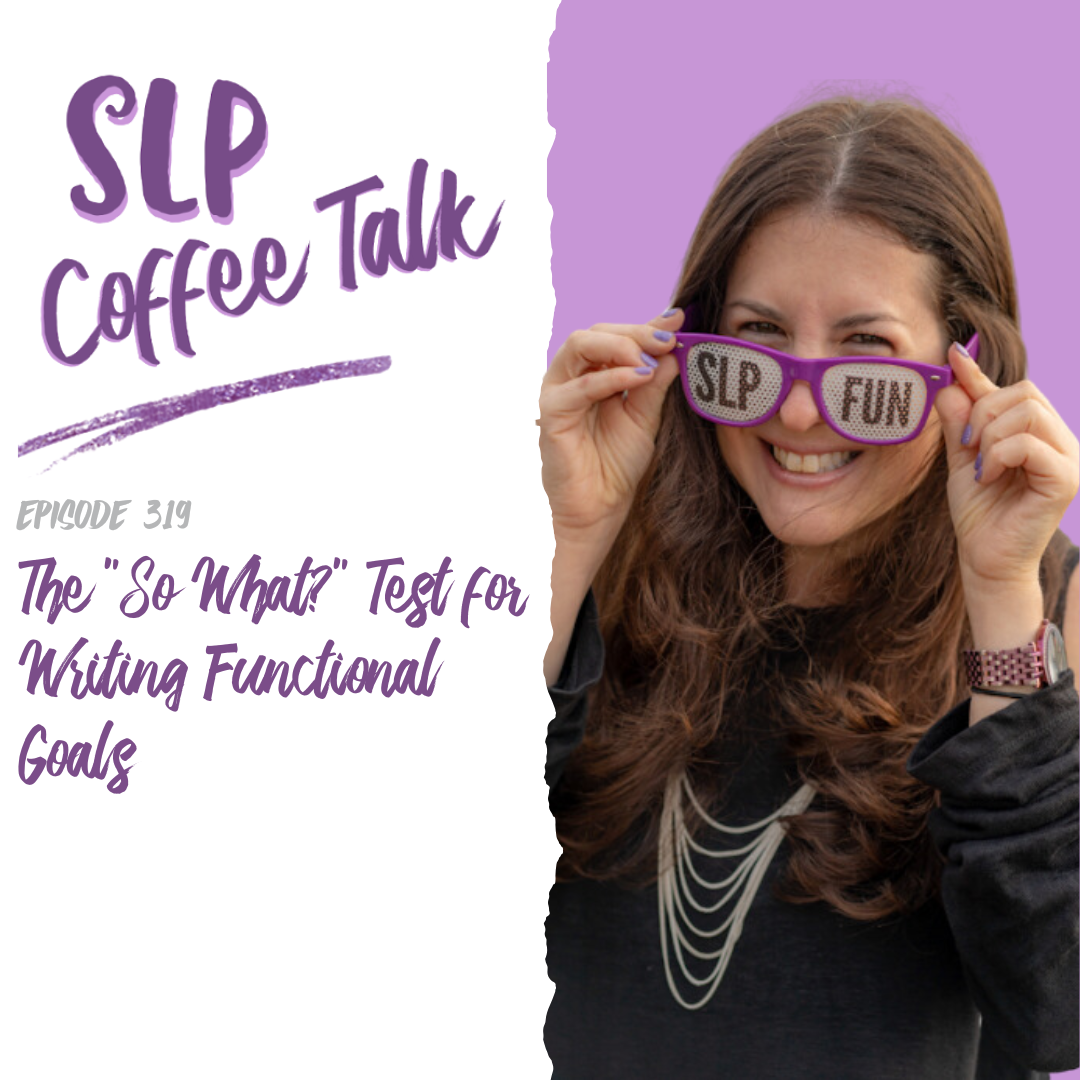
319: The “So What?” Test for Writing Functional Goals
Show Notes:
In this episode of SLP Coffee Talk, Hallie is serving up some real talk about IEP goal writing—and it might just change the way you look at your entire caseload. If you’ve ever stared at a goal and thought, wait, why am I even working on this? This one’s for you. Hallie introduces the “so what?” test—the one question you should be asking before you write any goal—and breaks down what functional actually means for different students. She’s covering how to write curriculum-linked goals without crossing into ELA territory, how to squeeze more mileage out of every session, and why our role as SLPs is way more powerful than we sometimes give ourselves credit for.
Here's what we learned:
- If you can’t answer “so what?” clearly and confidently, that goal might be more fluff than function.
- Functional isn’t one-size-fits-all—a college-bound student needs self-advocacy; a life-skills student needs to know how to tell the bus driver where they’re going.
- Overlapping with academics is fine—just do it through a language lens, not a reteaching one.
- One good goal can target syntax, vocabulary, comprehension, and organization all at once. Therapy charcuterie board—one activity, all the skills, everyone eats.
- We’re not tutors and we’re not ELA teachers—we’re the language experts. Writing functional goals is how we step into that power.
RESOURCES
📘✨ Grab your copy of The Secondary SLP Roadmap here! https://www.speechtimefunpd.com/stf-book
Learn more about Hallie Sherman and SLP Elevate:
JOKE OF THE WEEK:
Q: Why did the student eat his homework?
A: Because the teacher said it was a piece of cake.

Where We Can Connect:
- Subscribe to the Podcast
- Follow Hallie on Instagram
- Follow Hallie on Facebook
- Follow Hallie on Pinterest
Subscribe & Review on Apple Podcasts
Are you subscribed to the podcast? If you’re not, I want to encourage you to subscribe today so you don’t miss any future episodes! I already have so many amazing guests and topics lined up, I would hate for you to miss a single one! Click here to subscribe on Apple Podcasts.
Could I ask a big favor? If you are loving the podcast, I would LOVE it if you would leave me a review on Apple Podcasts. I read each and every review. Plus, you get to pay it forward because it will allow other teachers like you to find the podcast! Wondering how to leave a review? Click here to review, then select “Ratings and Reviews” and “Write a Review”. So easy and so appreciated!
Do you have a question you would like me to answer on the podcast?
GREAT! CLICK HERE TO FILL OUT THE FORM!
TRANSCRIPT
00:00:00 Hallie: Hey there, SLP friends. It is Hallie here, popping in with the best news ever. My new book, Secondary SLP Roadmap, is officially available. If you've ever wished for a clear, practical guide for working with middle and high school students, this is it. It is packed with real stories, ready-to-use strategies, and tools you can use right away. Grab your copy now, check the link in the show notes, or search Secondary SLP Roadmap on Amazon, and then of course, please do me a favor. When you are reading it, snap a picture and tag me on Instagram, @speechtimefun. I love seeing where you're diving in, the speech room, the couch, waiting in a doctor's waiting room, all the places. All right, ready? Go grab your copy, and let's make secondary speech feel doable and fun.
00:00:57 Hallie: Welcome to SLP Coffee Talk, the podcast designed exclusively for speech-language pathologists who work with older students, grades four through 12. I am your host, Hallie Sherman, your SLP behind Speech Time Fun, the Speech Retreat Conference, and the SLP Elevate Membership. And I'm thrilled to bring you conversations, strategies, and insights that will give you the jolt of inspiration that you need. Whether you're tuning in during your morning commute, on a break in between sessions, or even during a well-deserved relaxation time, I am here for you each and every week. Let's do this, SLPs.
00:01:37 Hallie: Hey, hey, and welcome to another episode of SLP Coffee Talk, the podcast where overwhelmed middle school and high school SLPs come to sip coffee, and of course, any age group, let's be clear. We welcome everyone. Well, you're here to sip some coffee, find your sanity, and get some practical inspiration to make speech feel doable again.
00:02:01 Hallie: Okay, what is today's topic? Okay, it is gonna be a biggie. We're talking about how to stop feeling like the school's unofficial language arts teacher, and finally start writing functional, meaningful, real-world goals that actually help our students succeed. You ever look at a goal on an IEP and think, wait, why am I working on that? Or do they really need to work on that for the fifth year in a row? Okay, yep, we are going there in this episode.
00:02:35 Hallie: Okay, the problem, am I teaching or doing therapy? Let's be real, when we start writing goals like define synonyms or identify idioms, it can feel like we're just hosting a mini English class in our speech therapy rooms. But here's the kicker, not every language skill that our students need to work on is worth targeting. I'm gonna say it again, not every skill is needed to be targeted. Yes, I said it.
00:03:08 Hallie: And that brings us to the golden question then, that we need to ask with every goal we write and even receive, so what? Okay, like truly, so what if they can define an idiom? Does that help them participate in classroom discussions? Does it support their independence with what skill? And does it show up in real world for them? Okay, just because they might need it for like one test or maybe one subtest that we gave them on like the CSSL or whatever. Okay, doesn't mean we have to work on everything. If you can't answer the question, so what clearly and confidently, that goal might just be more fluff than function.
00:03:55 Hallie: Okay, let's define functional, okay, by the student. Functional isn't a one size fits all word. It looks different depending on what student you are working with. And remember, they are independent IEP goals or IEP whatever, individualized for that student, okay? So is that student college bound? Think organization, study strategies, self-advocacy, okay? These kids need to know how to email professors, advocate for extra time, ask questions when they don't understand something and juggle deadlines like a pro. Are they on the life skills track? Focus on daily communication like phone calls, job interviews, navigating a grocery store or understanding consent. Forget metaphors, they need to know how to tell the bus driver where they are going.
00:04:45 Hallie: Students with major foundational gaps, don't skip past the basics. If your ninth grader doesn't know the difference between before and after, no amount of figurative language lessons is gonna help them write a paragraph. So that's where the so what test comes in again. If you're tempted to write a goal like identify 10 idioms in a text, pause. Ask, is this going to help them write better essays, speak more clearly, understand directions or navigate social situations? If not, toss it.
00:05:20 Hallie: Now I'm gonna put the disclaimer with following directions. We can be working on directions for years and years and years. We need to think of compensatory strategies to help them with these directions. We can't just keep writing these goals because on the self they had trouble pointing to those Xs and those Os, okay? We really need to think of functional directions that they are needed in the classroom and in society. Okay, we need to write curriculum linked goals without becoming the next ELA teacher.
00:05:50 Hallie: Okay, let's make peace with the fact that we are overlapping with academics. It's true, we work in a school, okay? Language is needed for reading. Language is needed to access the curriculum. So there is going to be an overlap, but let's do it in a language therapy way. They're already doing things in class, okay? So why do we need to bombard them with just the same things in a different setting?
00:06:14 Hallie: Think instead, how can I support this through a language lens? Instead of they will use an antonym in a sentence, let's try, given a writing prompt, the student will compose a sentence using a compare contrast structure with appropriate transition words. Now we are targeting syntax, heading to vocabulary words and supporting comprehension and making it functional AF because it ties directly into their classroom work, okay?
00:06:45 Hallie: And in case you were wondering, SLP Elevate is full of these kinds of materials to support them, okay? No fluff, no filler content, just functional meaningful activities that connect directly to what the students need and teaches it in a different lens, giving them those graphic organizers, using visual aids, helping them compensate for their weaknesses. It's all in there for you, not to worry. Anyway, and also we have those life skills type stuff. Anyway, moving on.
00:07:11 Hallie: How can we maximize the reach of every goal? I get it, we're busy. We have large caseloads. We're not just working with one student. We have mixed groups, okay? We are so busy that we're like hide in the bathroom just for silence kind of busy if you have time to even go to the bathroom. So we need to work smarter, not harder. We need to pick goals that hit multiple areas at once, such as summarizing. We're working on main idea and key details is also going to indirectly target syntax, comprehension, vocabulary, and organization. Working on WH questions from a nonfiction text is also gonna target listening, memory, and syntax and narrative skills, right? They have to formulate a sentence to be able to do so. They even need the vocabulary from the text to be able to understand it.
00:08:00 Hallie: These goals will pass the so what test because they're useful in class, helpful for life, and they're broad enough to adapt to any group but also targets some other indirect skills needed. Remember, these are annual goals. So that is what they're expected to do at the end of the year. And remember, we're not working on that annual goal all year long. So some of those like benchmarking things that we're gonna target indirectly can be some session goals that you were working on to help them get to that end goal, okay? It's kind of like a therapy charcuterie board. One activity, all the skills, everyone eats.
00:08:37 Hallie: I'm not saying you're goal smashing. I'm not saying you're working on predicting synonyms and inferencing all at once. I'm not saying you're working on WH questions and inferencing because those are two different levels of skills. But looking at what skills do they need to achieve that skill, I can also directly attack throughout the year that will benefit them. And that's something that the teachers are not doing.
00:09:04 Hallie: We're not a tutor. And that's where what we do is actually magical. When we write functional goals, we're stepping into our power as the language expert, not an ELA teacher, not a tutor, not a content coach. We're not here to just reteach with the ELA teacher covered. I get it. There are a lot of you out there that are probably yelling at me saying, I just help them with their homework. And if that's working for you and the students are motivated by it, keep doing what you're doing.
00:09:34 Hallie: But I'm here to show you that if you teach metacognitive skills, hello, visuals, graphic organizers, and the thinking about their thinking and you modeling, and so those kinds of things. If you're building processing skills, if you're improving generalization, and if you're empowering your students to advocate and communicate with confidence, that is speech therapy. That is why we are magical. And that is why our role matters.
00:10:03 Hallie: Okay. So here's a quick therapy idea that you can do to bring this all to life. You can find a high interest article or short video, such as like using [inaudible] News, which is free, teen friendly, or you can use any of the articles inside SLP Elevate. You can use it across all of your groups. Okay, you can take that article and you can work on vocabulary. You can define those tier two words inside that article. You can work on comprehension tasks. You can work on answering WH questions. You can work on expressing the main idea. You can work on summarizing. You can work on WH questions.
00:10:35 Hallie: If you have a written expression goal, the student can work on writing a summary with transition words. If your students are working on social skills, they can discuss and work on the author's perspective, or if the topic has a real world impact, or you can debate on the topic. One resource, multiple goals. It doesn't get more functional than that. And the best part is the students can benefit from hearing what the other students are working on. They might be needing to work on that too, but that's not their goal for this year.
00:11:04 Hallie: So why are we saying to them, hey student, just sit there, don't do anything, or work on something independently while I work on with this student. How is that benefiting them? They can all benefit from one, learning from each other, but also seeing that everyone is working on something differently, and everyone has things that are difficult for them, and we're all making progress together, okay?
00:11:25 Hallie: So hopefully you needed this one. But again, in SLP Elevate, you get those articles and those follow-up activities to do all these things that I just mentioned. So not to worry, okay? So remember, functional doesn't have to mean boring. It means relevant, real world, and rooted in what our students actually need. So the next time you're writing a goal, pull out your imaginary rubber stamp and ask, so what? If the answer is not much, rewrite it. If the answer is this will help them crush school and life, run with it, okay?
00:12:03 Hallie: So, and my joke for you guys, why did the student eat his homework? Because the teacher said it was a piece of cake. Until next week, everyone, stay flexible, stay creative, but most importantly, stay out of trouble.
00:12:24 Hallie: Thanks so much for tuning in to another episode of SLP Coffee Talk. It means the world to me that you're tuning in each and every week and getting the jolt of inspiration you need. You can find all of the links and information mentioned in this episode at my website, speechtimefun.com. Don't forget to follow the show so you don't miss any future episodes. And while you're there, it would mean the world to me if you would take a few seconds and leave me an honest review. See you next week with another episode full of fun and inspiration from one SLP to another. Have fun, guys.