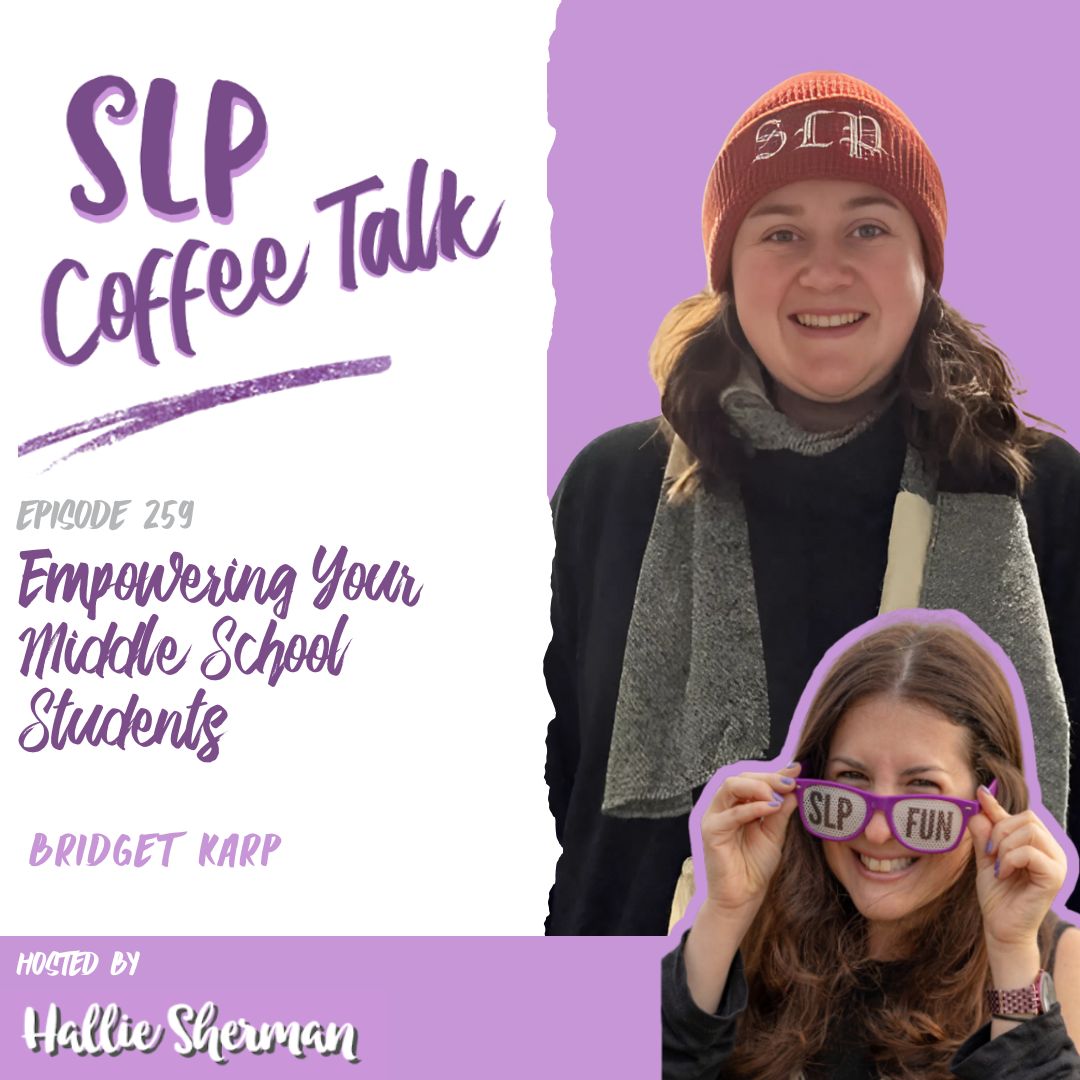
259: Empowering Your Middle School Students
Show Notes:
This week on SLP Coffee Talk, Hallie sits down with Bridget Karp, a passionate and experienced speech-language pathologist specializing in middle school therapy. Bridget has six years of expertise across various settings, including public and private schools and early intervention. She combines her knowledge with dedication in helping her students develop confidence and autonomy.
Bridget talks about how tools like SLP Elevate have streamlined her planning process, making sessions both fun and effective. She shares tips in keeping therapy engaging such as tailoring activities to students' interests, promoting self-advocacy, and incorporating playful methods. See how small choices and thoughtful planning can make a big difference for middle schoolers, making your sessions more impactful and stress-free!
Here's what we learned:
- Middle school students thrive when given autonomy and ownership in sessions.
- Simple, student-led activities like games can make therapy more effective.
- Tailoring content to student interests boosts engagement and progress.
- Tools like SLP Elevate save time and offer flexible, age-appropriate materials.
- Empowering students to advocate for themselves is critical at the middle school stage.
RESOURCES
Check out Bridget's Instagram: https://www.instagram.com/bktheslp/
Learn more about Hallie Sherman and SLP Elevate:
🎧 Check out the Secondary Secret Podcast here!
JOKE OF THE WEEK:
Q: What sort of cakes do snowmen like
A: Any cake with lots of icing!


Where We Can Connect:
Subscribe & Review on Apple Podcasts
Are you subscribed to the podcast? If you’re not, I want to encourage you to subscribe today so you don’t miss any future episodes! I already have so many amazing guests and topics lined up, I would hate for you to miss a single one! Click here to subscribe on Apple Podcasts.
Could I ask a big favor? If you are loving the podcast, I would LOVE it if you would leave me a review on Apple Podcasts. I read each and every review. Plus, you get to pay it forward because it will allow other teachers like you to find the podcast! Wondering how to leave a review? Click here to review, then select “Ratings and Reviews” and “Write a Review”. So easy and so appreciated!
Do you have a question you would like me to answer on the podcast?
GREAT! CLICK HERE TO FILL OUT THE FORM!
TRANSCRIPT
00:00:00 Hallie: Hey there SLP, working with grades 4 through 12. New school year, new you. Let's not go into this school year feeling overwhelmed and behind on paperwork. Let's not worry about students asking why they are coming to speech. Let's not have students shrug in their shoulders and looking at you saying, why am I here? I don't wanna be here. Let's instead have your students excited to come to speech, ready to take on the challenges you provide and make massive progress towards their goals.
00:00:30 Hallie: If you are ready to make this school year, the year that you leave work promptly at the end of the day, plan in an hour or less a week and go into every session confident that your students will grasp the session objectives, then SLP Elevate is just what you need to make this school year a successful one. Either go to slpelevate.com or send me a DM on Instagram with the word culb, C-U-L-B, and we can discuss if SLP Elevate is right for you and your students. Now is the time to get your time back. And now is the time to get your students excited to come to speech. SLB Elevate is perfect for you.
00:01:15 Hallie: Welcome to SLP Coffee Talk, the podcast designed exclusively for speech language pathologists who work with older students, grades 4 through 12. I am your host, Hallie Sherman, your SLP behind Speech Time Fun, the Speech Retreat Conference, and the SLP Elevate membership. And I'm thrilled to bring you conversations, strategies, and insights that will give you the jolt of inspiration that you need. Whether you're tuning in during your morning commute, on a break in between sessions, or even during a well-deserved relaxation time. I am here for you each and every week. Let's do this SLPs.
00:01:56 Hallie: Hey, hey, and welcome to another episode of SLP Coffee Talk. It is the second week of January and I wanted to bring on Bridget Karp here because she is not only an amazing SLP, but she's also an SLP Elevate member. And I know that so many of you will have questions that you wanna hear answered about her experiences using the resources and working with older students. So Bridget, welcome to the show.
00:02:23 Bridget: Thank you so much for having me.
00:02:24 Hallie: Tell everyone a little bit more about you and your SLP journey.
00:02:28 Bridget: So this is my sixth year as an SLP. I currently work at a public middle school. And before this, I've worked in other middle schools in California. I've also worked a little bit in early intervention and at public or private schools, excuse me, as well. But currently, I'm in my third year at my current middle school.
00:02:55 Hallie: What were some challenges when you first started working with that age group?
00:02:59 Bridget: So my favorite thing, but also what's challenging, is learning how to mesh with their personality while providing therapeutic benefits. Sometimes they want to be somewhere else, do something else. So for me, it's about finding what works for them and how we can target their goals but still make it fun. And they're also figuring themselves out, who they are, what they like, what they don't like. And so they're learning that and I'm learning that about them too. So I like this age group because you're really seeing them grow up, which I think is a lot of fun.
00:03:42 Hallie: Were you surprised to find that you like working with this age group?
00:03:45 Bridget: Yes, I initially wanted to work with elementary students when I first started my career after getting my license. And even at the beginning, when I was in my CF, I wanted to work initially with elementary students. And the position they had available was for middle school and high school. And I grew to love it and I've tried a few other populations since then, but ultimately came back to middle school. And I think for anyone that is maybe curious about it, definitely give it a go if it's an option for you. You might find that you really like it.
00:04:27 Bridget: I've had a graduate student that just started her SLP career and she again had the same thought processes I did. And then after her internship with me, she decided to take a job at a middle school. Watch, you got her Cs. So I love it. It has its challenges, but I think all settings do. And I think a lot of people could thrive at middle school if they give it a chance.
00:04:57 Hallie: I so agree. I so agree. And I felt the same exact way when I went on the interview with my final district in my career. And they're like, so we're going to put you in the fifth and sixth grade. I'm like, what? What? I'm like, I thought it was elementary. And I'm like, OK, a job is a job. I got to just take it. I need to pay the bills. So I took it.
00:05:16 Hallie: And I was shocked to find also that I was like, oh, one, less evaluations. That was a perk for me. I was like, less initials, because they've already been like classified at this point. All right, works for me. I was like, I was not tying shoes as much. I didn't wanna say at all, as much anymore. There were some needs still of the shoe lacing, but I was shocked to find that as well. I was like, wow. And then I go out after that called the job security because no one wanted to switch with me.
00:05:47 Bridget: Yeah, this is my third year at middle school and I was open to another placement, but ultimately I stayed and it's been good so far. Yeah.
00:05:57 Hallie: I mean, I shared the no tying of the shoes and the evaluations. What would you say other than like you said, what would you say would be like an aha moment you've had working with this age group? Like that just has surprised you.
00:06:09 Bridget: I would say how much they like simple games and simple activities. I think we often think as students get older that the things we do with them need to be really complex, but in actuality they like things that are simple and what I like about this age group too is that they will tell you if they don't like something or if they want to switch activities more readily than maybe an elementary schooler that I found in my experience.
00:06:46 Bridget: But you also have a little more freedom with what you do with them is what I found. They aren't expecting to play a game the entire session. Or if they play a game, it'll be one that you can really tailor to their goals. And so that's what I really appreciated is I still use a framework of play and student or child led, which is doable. I think a lot of folks that work with older students don't think that's a possibility, but it definitely is.
00:07:24 Bridget: And I've noticed my sessions go even better if it's student led or partially student led versus this is what we're doing and they have no say. This is an age where they're also pushing the boundaries a little bit, seeing what they can and cannot do. And so I like my room to be a safe place for them to explore those boundaries in a respectful way.
00:07:50 Hallie: I love that. Do you have a favorite game? Do you like to play with them?
00:07:53 Bridget: Right now, I have a couple students that we're doing Monopoly with, and that has been a lot of fun. We are working on articulation sounds. And so I said, go ahead, you know, we did a reading and then I said, we have some extra time, go ahead and pick out a game for us. And surprisingly, that's what they picked. And it's one of my favorites. It does take some time. So I have it in the back of my room and we come back to it each week.
00:08:26 Bridget: But the kids really like a game called, I think it's called Smackin' Snack. It's by Goliath Games. It's a little vending machine and it has little snacks that you put in, you push, and then the end of the game is signaled by food monsters that come out of the sides. So that's been a hit. So a lot of those games with kind of moving parts are super popular, not just with middle school, but elementary. I've worked with older students as well that are super into those kinds of games too.
00:09:00 Hallie: I love it. And the snack one, it doesn't require batteries or anything like that, guys.
00:09:04 Bridget: I don't believe so, yeah.
00:09:06 Hallie: It's like the crocodile dentist, like you don't know when it's gonna pop.
00:09:09 Bridget: Yeah, exactly.
00:09:09 Hallie: I think kind of things. I love it, so much fun. What would you say is your favorite goal to work on with the stage group?
00:09:22 Bridget: I really like articulation is probably one of my favorite areas. And I do have quite a few articulation students on my caseload. Most of them are for R. Some of them are K and G.
00:09:41 Hallie: Interesting.
00:09:42 Bridget: Yeah. And so it's been interesting to figure out how to navigate that process of working with those students. But I have graduated a few students, not this year because we're still early in the year. But the past couple of years, I've been able to really work with students on their articulation and get them to a place where they feel confident about their speech, they're producing their sounds regularly.
00:10:13 Bridget: I also say I really like self-advocacy goals, where I have stuttering students that have self-advocacy goals, language students with self-advocacy goals, because that's a big part of communication, especially at this age when you've transitioned from the adults are always in charge and they tell you what to do in a way versus when you're in middle school, a lot of the ownership falls on you. Like, you have to finish your homework and be responsible for your homework and you have to be respectful and kind to peers and teachers. I like this self advocacy goals because they really transition nicely from middle school to life beyond.
00:11:04 Hallie: I love that, especially when they have more teachers and there's more bodies and every teacher has a different teaching style. And they need to be able to advocate for themselves in case the teacher forgets to give them preferential seating or time or whatever.
00:11:24 Bridget: Yeah.
00:11:25 Hallie: If they don't speak up, they can't wait for mommy to do it anymore.
00:11:29 Bridget: Right.
00:11:31 Hallie: Like at that point, by the time they tell mommy.
00:11:33 Bridget: Right. Exactly.
00:11:35 Hallie: They might take out their phone and text her, but let's be real here. I love that. And that's so often, articulation can be challenging with the older ones because they're tired of it. They are frustrated. Like, all my friends have graduated. I don't want to be here anymore. But they're also very, it might be more aware of their difficulty speaking. They might be embarrassed about it.
00:11:59 Bridget: Definitely.
00:12:00 Hallie: How are some ways you tackle that?
00:12:03 Bridget: So to keep therapy engaging, I like to use your materials because at the beginning of the school year, I do a little questionnaire or survey to learn about their interests. And I can usually find a passage about something that is kind of in their wheelhouse of interests. So if they really like pizza or candy, I can usually find a food passage or something that might interest them. I have a lot of kids that are into science, different science topics. So there's great passages there.
00:12:44 Bridget: And then that child led, play based kind of therapy is also, I think a great way to encourage kids to keep coming to speech, where if I just say, hey, we're gonna read this passage, yes, it might be something interesting for them to read about, but oftentimes I'm doing mixed groups. And so sometimes it might be of high interest to one student and the other student may be interested, but not as much.
00:13:21 Bridget: So when I bring in that play-based, student-led side of my sessions, I feel that it encourages them and they know that, hey, this is a safe place. This is where we are working on our goals, but it's also a time, a place where we can have fun. Miss Karp, that's what the students call me, gives me choices. She allows me to pick the passage we read or I get to pick a game once we finish our passage and read our goals.
00:13:59 Bridget: So I think allowing them to make some choices during your session is really helpful because it gives them ownership of what they're doing and allows them to feel safe and valued and not like someone's just making them come to speech each week. So I think really that idea of ownership and autonomy is really helpful for our middle school students and beyond as well.
00:14:29 Hallie: So, so true and so helpful. And we have so many themes on there for science. You have the artificial intelligence, we have natural disasters, we have, oh my goodness, cool science. So many in there and more to come, so.
00:14:42 Bridget: Yeah.
00:14:43 Hallie: You're right, but there's tons of things on there for any theme, any interest. I love it that not only are you giving them the empowerment to pick whatever they want to do, but it shows them that you care and that you're listening. It's not like, hey, what are you into? And I'm just never going to use it. You're actually utilizing that information they gave you. She actually remembered what I said last week.
00:15:05 Hallie: Because so often when they are going throughout their day in math class, science class, they don't have that luxury of, oh, I'm going to learn something that I'm into. I just have to go through the motions and it's hard for me and it's boring and it's whatever. And we want to be that place in their day where they get to feel empowered, respected, valued. So I love that. What are some other ways that SLP Elevate has helped you make just planning easier for yourself?
00:15:37 Bridget: Yeah, so I print out a variety of passages from SLP Elevate. And then I have a spinning wheel and I write all of the options for passages because again, I like that idea of allowing students to have some choice. I'm not gonna say, hey, pick a passage from 100, obviously, but I might have six different options and then they get to spin the wheel and that's a fun way for them to do it. Sometimes I'll say, hey, I have these two passages. I know you really like candy. There's one about gummy bears and there's one about chocolate. Which one would you like to read?
00:16:20 Bridget: So I like the variety of passages on SLP Elevate. And also the level of passages, I tend to go for the ones that are longer because I get more articulation repetitions that way. For my students that stutter, it gives them more opportunities to either use open stuttering, if that's a strategy they have opted for, or if they have chosen other strategies to use.
00:16:54 Bridget: So I let them have that choice. And it takes a lot of time that I may have used for planning in the past and allows me to work on other things because as we all know, we as SLPs wear many hats and have many little projects going on all the time.
00:17:20 Bridget: I also like how there are different worksheets for different goals, so vocabulary, reading comprehension and I can use those. But the passages are also flexible in that maybe I want to work on verbs with students, and I can look in the passage and look at the verbs and see, okay, this passage has some great past tense verbs, and that's a goal students working on.
00:17:51 Bridget: And with the worksheet, this is a tip for anyone that works in schools and that might use SLP Elevate or maybe interested. Instead of printing multiple copies of the worksheets, of the readings or the worksheets that you can write on, the vocabulary ones or things like that. I use, I think they're called dry erase sheet, where it's kind of like a sheet protector. They're just on Amazon. It's like a dry erase board, but they're clear. And so each session I have, I just put the passages in there.
00:18:33 Bridget: And oftentimes when I ask students questions, I have them highlight their answer. But instead of having to print 20 copies, I just have a few, have them highlight, make note of their answers, and then erase it and use it for the next group. So if you get the SLP Elevate membership and you want to use the passages, but you don't wanna print 20, 40, 60 copies. I would highly recommend those. So then that also kind of leaves room for prep. You're not spending tons of time printing things and organizing papers.
00:19:17 Hallie: So true, I love that. I was always afraid of jamming the photocopying machine. So I was afraid of it.
00:19:23 Bridget: Yeah, that's fair.
00:19:24 Hallie: Another reason I would fall for like dry erase sleeves. I'm like, if I don't need a photocopying machine with 65 plus students and, but also the benefit of that is you're taking a pencil away from a student and lending them right with dry erase markers. Another empowering thing for your students, like, hey, you don't need to use a pencil, you can use something else. What color?
00:19:45 Bridget: Yeah. And sometimes it's when I first started using those, because I did initially when I started in schools do paper and pencil. I didn't know the wiser. And then when I got these dry erase markers and sleeves. I didn't think much of them. I thought, yeah, these are gonna be helpful. But yeah, I have six dry erase sleeves and they all have different colors around the rim. So I let them pick their dry erase sheet and they get to put their worksheet in there. And then I let them pick a marker color.
00:20:17 Bridget: And surprisingly, some students really were into it. They're like, ooh, look at all the colors. And I think it just gives them that sense of choice and that it doesn't have to be so strict. We're not making all of the choices for them. So I think it just, giving them choices, not all of the choices, but giving them some choice also is empowering and encouraging for them.
00:20:47 Hallie: I love that. How have you feel it has helped you just be like more confident and more ready to go each and every day?
00:20:59 Bridget: Yeah, I think for me, before I would try to look everywhere for passages to read, and I would spend hours on TPT trying to find appropriate materials for my students. And with middle school, it is more difficult because you have some students that are reading at a fourth grade level, but they're in sixth grade. And you have some students that are reading at grade level and still other students that maybe their reading's a little more advanced or they like topics that maybe haven't been discussed a lot before.
00:21:38 Bridget: So what I like about SLP Elevate is the different leveled readings. And I'm not having to search everywhere for materials that are going to work for my students. So it takes a lot of time away from having to research and look for materials which used to take me a long time. And sometimes what I found wasn't exactly what I was hoping for. It worked, but not as well as I had hoped. So with SLP Elevate, it just takes a little less time to find materials that are going to work and just the variety of topics has been helpful as well, especially if you're middle school or secondary.
00:22:33 Hallie: Awesome. Well, in any case, you get brand new themes each and every month. We have not missed a month and you've access to all the previous ones. So if you missed anime month, it's okay. You can get access to it. If you missed Minecraft month in December, it's okay. You have access to it.
00:22:52 Hallie: And that was something that was so hard for me early on in my career, is that my students were sixth grade reading at a first grade level, and things that I was finding on Teachers Pay Teachers or where else would look like a first grade worksheet. I couldn't provide them a first grade worksheet, and walking confidently, like with my head held high, like, hey, I'm here to help you.
00:23:14 Bridget: Yeah. Because I found that they know when things are meant for younger children. They pick up on things pretty quick. And so that's why I like SLP Elevate because their passages meant for students their age. And you wouldn't say, oh, this looks like it's for a first grader. You know it's for meant for a middle school student. So I like that aspect of it as well.
00:23:50 Bridget: And the themes I have found are really fun and a great variety of themes has been really helpful because I have students with a wide variety of interests. Some of them are pretty niche. I've had students that are obsessed with axolotls and very, very specific things, which is great. And then I have other students that have interests that a lot of middle schoolers have Minecraft as a big one, Roblox, Pokemon, et cetera.
00:24:24 Hallie: And that's why we're always adding, as we find things that students are into that we have not hit yet, we are adding to it. And if you guys are listening, in January, the theme is healthy habits. So all things, New Year's resolution type, related type things. So get excited for that one. Any last bit of advice or anything you'd like to share for anyone listening, want to learn more?
00:24:55 Bridget: Yeah, I think it's important to ask for help. And if you are having any trouble as an SLP at the middle school level, find those people that are going to support you and have tips. I've had a few people reach out to me. They know my experience as a middle school SLP or secondary SLP. So I found that just reaching out to people and building a community, whether it's through SLP Elevate, I've met Hallie and many other amazing people through the membership and some of the talks that have been available there.
00:25:38 Bridget: And just really building that community of support has been incredibly helpful and I think also you have invaluable experiences as well. Even if you're brand new to the career or whether you're like myself, you've been in it for a little bit but still relatively new or whether you've been at this for 20 plus years, there's always something valuable to share about what you've done or what you plan to do. So really build that community however you can.
00:26:13 Hallie: Those are true. The field is always changing and there's always more to learn. Like, hey, like the neurodiversity affirming movement, like that was not something, you know, when I started my career, most 20 years ago, that was not a thing. Even like AAC, there was no iPads. There's just so many things that are constantly changing. And by having the community and having the support makes you feel not alone, especially when not often do you get professional development that's appropriate and trainings through your, you know, district or employment. Thank you so, so much Bridget. Where can people learn more about you and what you like to share?
00:26:52 Bridget: Best place is Instagram. I'm on there quite a bit. My username is bktheslp. And if you message me there, we can connect in other ways, but that's the best way to reach me and see what I do as an SLP. You'll see a lot of middle school content but also a lot of support for SLPs when it comes to mental health. And if you are someone that's just starting their career, maybe you're a CS, a graduate student, I try to post things that hopefully make you feel empowered as well.
00:27:35 Hallie: Thank you so much Bridget for sharing your experience as a middle school SLP and as an SLP utilizing SLP Elevate. I always end my episodes with a joke because jokes build rapport. They're fun and very language based. So what sort of cakes do snowmen like?
00:27:54 Bridget: What cakes?
00:27:55 Hallie: Any cake with lots of icing. I am, my corny dad jokes, but I'm chink eyes. Until next week, everyone, stay out of trouble.
00:28:12 Hallie: Thanks so much for tuning in to another episode of SLP Coffee Talk. It means the world to me that you're tuning in each and every week and getting the jolt of inspiration you need. You can find all of the links and information mentioned in this episode at my website, speechtimefun.com. Don't forget to follow the show so you don't miss any future episodes. And while you're there, it would mean the world to me if you would take a few seconds and leave me an honest review. See you next week with another episode full of fun and inspiration from one SLP to another. Have fun guys!